
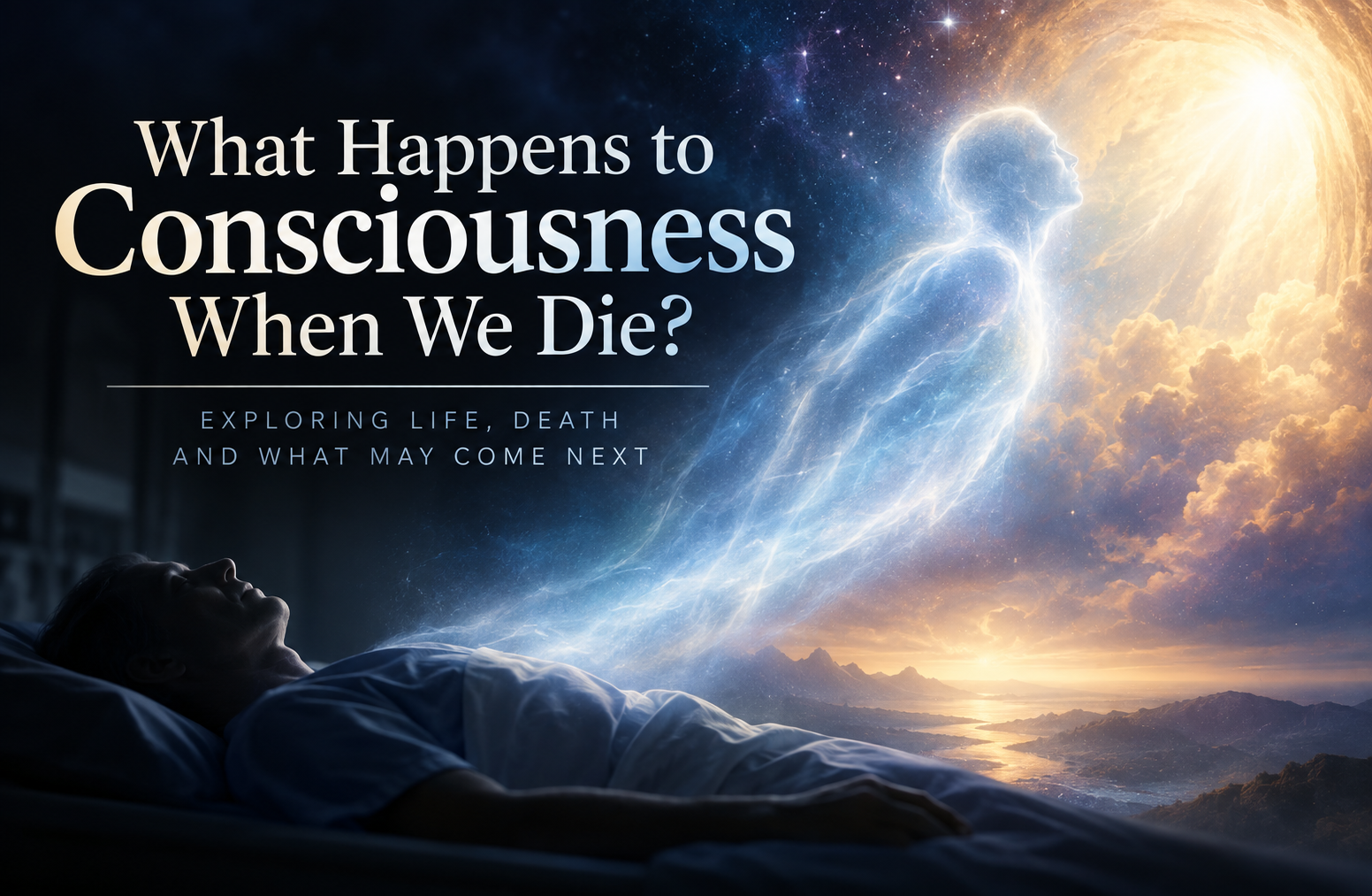
What Happens to Consciousness When We Die?
Author's Note: This article is intended simply as a thought-provoking exploration of consciousness and some of the questions surrounding it. It is not intended to support, challenge, or contradict any religion, spiritual tradition, or personal belief system, nor should the ideas explored here be interpreted as a statement of my own personal beliefs. The concepts discussed are questions and possibilities—not statements of fact, faith, or personal conviction.
There is a moment coming for every one of us.
The heart stops.
Blood circulation stops.
The brain begins losing the oxygen it needs to function.
And eventually, the incredibly complicated biological machine we call the human body shuts down.
But then comes the question we have been asking for thousands of years:
What happens to us?
Not our body.
Us.
If consciousness is entirely produced by the brain, the answer seems relatively straightforward. When the brain permanently stops functioning, consciousness stops too.
The experience ends.
But in my last article, What If Consciousness Doesn't Come From the Brain?, I explored another possibility.
What if the brain doesn't actually create consciousness?
What if it receives it, filters it or somehow connects our physical body to something that exists independently of it?
If that possibility is even remotely correct, then death becomes a very different question.
Because when the receiver breaks, the signal doesn't necessarily disappear.
The Simplest Explanation
Let's start with what modern neuroscience can demonstrate.
Damage the brain and you can change personality, memory, perception and behavior.
Anesthesia can seemingly switch consciousness off.
Drugs can dramatically alter our experience of reality.
Stimulate certain areas of the brain and strange experiences can occur.
There is an enormous amount of evidence connecting what happens in the brain with what we experience as consciousness.
The conventional explanation is therefore perfectly reasonable:
The brain creates consciousness. When the brain dies, consciousness ends.
That may ultimately be the answer.
But there are some fascinating observations that make me wonder whether the story is quite that simple.
Near-Death Experiences
Near-death experiences are probably the most famous part of this mystery.
People who come close to death sometimes report remarkably vivid experiences: leaving their bodies, seeing deceased relatives, traveling through darkness or toward light, experiencing an overwhelming feeling of love or peace, or reviewing events from their lives.
There are biological explanations proposed for many aspects of these experiences.
A brain under extreme physiological stress is not a normal brain. Oxygen changes, carbon dioxide levels, neurotransmitters, medications, anesthesia and the process of recovering consciousness could all potentially contribute.
But some cases raise an interesting question.
People occasionally report events they believe occurred around them while they were unconscious or being resuscitated.
That doesn't prove consciousness left the body.
But it creates something researchers can potentially test.
If a person accurately perceives information they could not have obtained through normal sensory pathways, we have something much more interesting than simply describing a bright light.
That is why research into cardiac arrest and near-death experiences interests me so much.
We can actually ask:
When the brain is severely compromised, what—if anything—is still being experienced?
The Strange Return Before Death
There is another phenomenon I find fascinating: terminal lucidity.
There are reports of people with severe neurological impairment or dementia unexpectedly becoming clear and communicative shortly before death.
Someone who may have been confused or largely unable to communicate can seemingly return for a brief period.
They recognize family.
They speak.
Their personality appears again.
And then they die.
Not every reported case is well documented, and we still don't understand the biological mechanisms that could produce these episodes.
But conceptually, terminal lucidity presents an intriguing question.
If the brain is the storage location for everything that makes that person who they are, how does severe damage sometimes appear to loosen its grip shortly before death?
Perhaps there is a neurological explanation we haven't discovered yet.
Or perhaps our model of the relationship between the brain and consciousness is incomplete.
Then There Are the Children
This is where the subject gets even stranger.
Researchers, most famously at the University of Virginia, have spent decades studying young children who report apparent memories of previous lives.
Some children describe names, locations, occupations, family members or circumstances surrounding a person's death.
Researchers then attempt to determine whether those statements correspond to an actual deceased individual.
Again, this does not prove reincarnation.
There are alternative possibilities that have to be considered: coincidence, information unknowingly obtained from adults, selective reporting, cultural influence and mistakes made while matching cases.
But after thousands of reported cases, I don't think the subject deserves to simply be laughed away.
It deserves investigation.
Because if even one case could eventually be demonstrated under sufficiently controlled conditions, our understanding of consciousness would have to change dramatically.
What If Death Is a Disconnection?
So let's return to the thought experiment from my previous article.
Imagine consciousness isn't produced entirely inside the brain.
Instead, imagine the brain is some combination of receiver, filter and interface.
Your brain allows consciousness to interact with this particular body.
Your senses provide information about this particular environment.
Your memories and personality create this particular human experience.
In that model, death might not destroy consciousness.
It might disconnect it.
Think about turning off a television.
The people on the screen disappear.
The sound disappears.
The picture disappears.
But the broadcast didn't necessarily cease to exist.
The television simply stopped receiving it.
That's only an analogy. It isn't evidence.
But it demonstrates how dramatically our assumptions about death depend upon our assumptions about consciousness.
If the brain creates consciousness, death probably represents the end of individual conscious experience.
If the brain receives or filters consciousness, death could represent something entirely different.
And Then What?
This is where science currently runs out of road.
Maybe consciousness ends.
Maybe some component continues.
Maybe individuality remains.
Maybe we return to some larger form of consciousness.
Maybe reincarnation is real.
Maybe religions throughout human history have been attempting to describe fragments of something humans have experienced but never completely understood.
Or maybe death really is simply the end.
I don't know.
And I think those three words are important.
I don't know.
None of us does.
But not knowing is very different from saying something is impossible.
For most of human history, we have approached this question primarily through religion and philosophy.
Today we have another tool.
We can investigate.
We can study near-death experiences.
We can document terminal lucidity.
We can investigate children's reported memories.
We can study the brain during cardiac arrest and resuscitation.
We can design experiments attempting to determine whether perception can ever occur without ordinary sensory access.
And we can follow the evidence wherever it leads—even if the eventual answer is that consciousness really does end when the brain dies.
Maybe We're Asking the Wrong Question
We normally ask:
What happens when we die?
But perhaps there is a question that has to come first:
What are we before we die?
If we are biological machines that somehow generate consciousness, then death may simply switch the machine off.
But if consciousness is something more fundamental—something the brain accesses rather than creates—then the death of the body might not be the death of the observer experiencing life through it.
And suddenly one of humanity's oldest questions becomes a scientific one.
Not:
Is there an afterlife?
But:
Can consciousness exist without a functioning brain?
I don't know the answer.
But I increasingly think that's one of the most important questions we can ask.
More from Scott Turnmeyer
I write about photography, business, mindset, bowling, and the bigger questions that don’t always have easy answers. You can explore more articles, photography, and projects here:
Blog Home
About Scott Turnmeyer
Fine Art Photography
Photography Workshops & Experiences
Digital Consulting