
What If Consciousness Doesn't Come From the Brain?
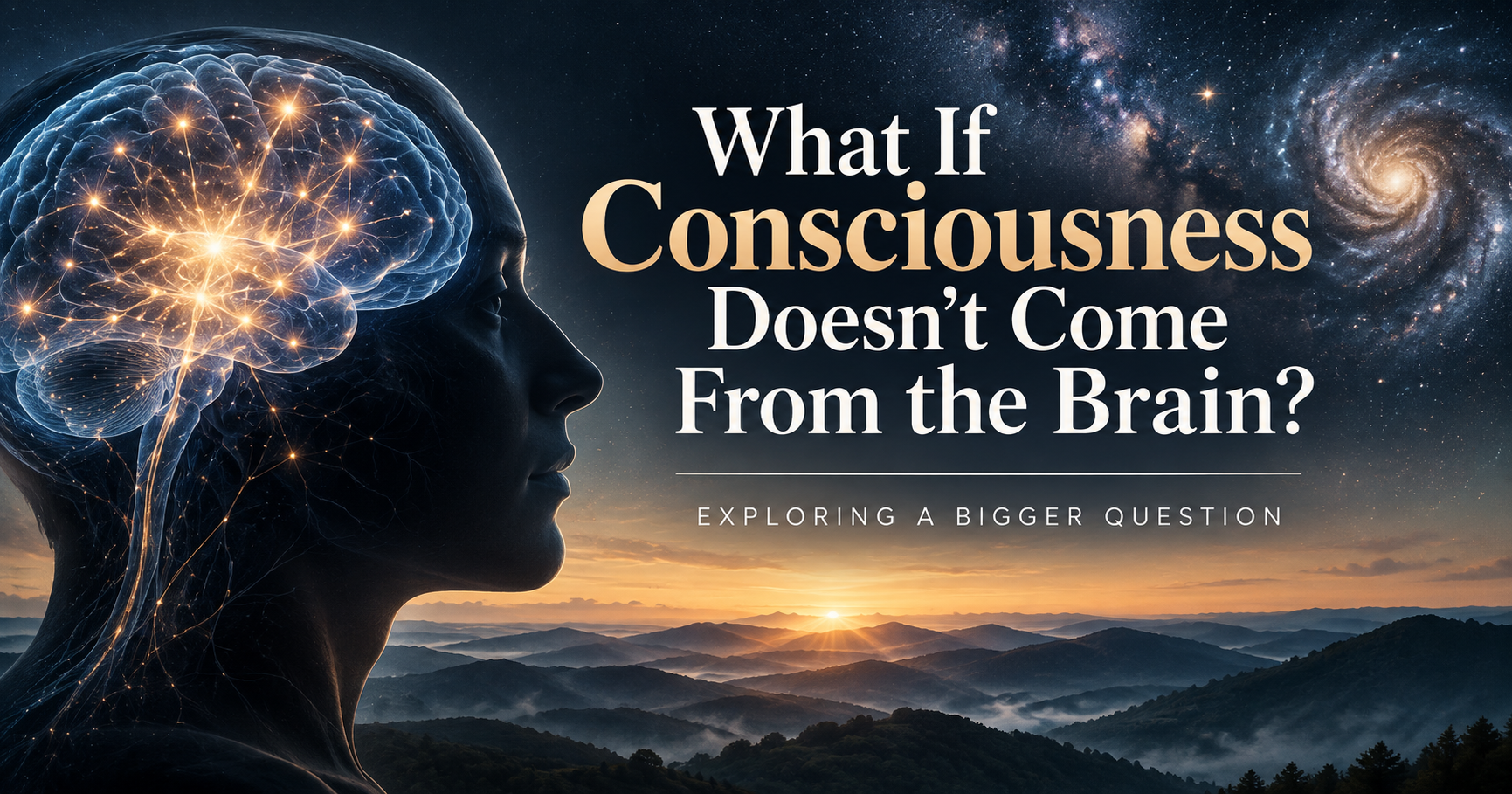
Author's Note: This article is intended simply as a thought-provoking exploration of consciousness and some of the questions surrounding it. It is not intended to support, challenge, or contradict any religion, spiritual tradition, or personal belief system, nor should the ideas explored here be interpreted as a statement of my own personal beliefs. The concepts discussed are questions and possibilities—not statements of fact, faith, or personal conviction.
For most of my life, I assumed consciousness was pretty simple.
The brain creates it.
Billions of neurons communicate through electrical and chemical signals, and somewhere within that extraordinary biological machinery emerges the experience we call us.
Our thoughts. Our memories. Our emotions. Our awareness.
When the brain stops functioning, consciousness stops too.
It's a reasonable conclusion. And there is enormous evidence connecting what happens in the brain with what happens in our minds.
But there's an interesting distinction hiding inside that statement.
We know the brain is deeply involved in consciousness.
Do we actually know that the brain creates consciousness?
Those aren't necessarily the same thing.
And once I started thinking about that distinction, I found it difficult to stop.
The Problem We Still Haven't Solved
Neuroscience has become remarkably good at studying the brain.
We can observe changes in brain activity when someone sees a face, experiences pain, remembers something or makes a decision. Damage particular areas of the brain and specific abilities can disappear or change.
Clearly, the brain matters enormously.
But there remains a deeper question:
Why does any of that activity produce an experience?
Imagine looking at a sunset.
Science can investigate light entering your eyes, signals traveling through the optic nerve and activity occurring throughout the brain.
But somewhere in that process something remarkable happens.
You don't simply process information about a sunset.
You experience one.
There is something it feels like to see the colors.
Something it feels like to be you.
Philosophers and scientists have wrestled with this problem for centuries. Philosopher David Chalmers famously described part of it as the "hard problem of consciousness."
We can increasingly explain what the brain does.
Explaining why any of it should produce subjective awareness is considerably harder.
What If We're Looking at It Backwards?
Here's the thought experiment that fascinates me.
What if the brain doesn't generate consciousness?
What if it interacts with it?
Think about a radio.
Music comes out of the speaker. Damage the speaker and the music becomes distorted. Damage other components and perhaps certain frequencies disappear. Destroy the radio completely and the music stops coming from it.
If you knew nothing about radio waves, you might reasonably conclude that the radio created the music.
But it didn't.
It received and translated something that existed independently of the device.
Could the relationship between consciousness and the brain be remotely similar?
To be clear, the radio analogy isn't evidence that consciousness exists outside the brain.
It's simply a useful way of illustrating an alternative possibility.
The brain could conceivably be a generator.
But perhaps it could also function as a receiver, filter or interface.
And those possibilities lead to very different interpretations of what consciousness actually is.
The Brain-Consciousness Connection Doesn't Settle the Question
One obvious objection is that changing the brain clearly changes consciousness.
Alcohol changes consciousness.
Anesthesia changes consciousness.
Brain injuries can change personality.
Neurological diseases can affect memory, perception and behavior.
Surely that means consciousness comes from the brain.
Maybe.
But consider the radio analogy again.
Changing the circuitry changes what comes through the speaker even though the circuitry isn't creating the original signal.
If the brain were some kind of interface with consciousness, altering the interface should alter the experience.
Again, this doesn't prove the receiver hypothesis.
It simply shows why the relationship between brain states and conscious states doesn't automatically answer the deeper question of where consciousness originates.
Then There Are the Strange Cases
This is where the subject gets even more interesting.
There are categories of human experiences that researchers continue to investigate because they don't fit neatly into our everyday understanding of consciousness.
Near-death experiences are one example.
People revived after cardiac arrest sometimes report extraordinarily vivid experiences: observing events from outside their bodies, encountering deceased relatives, moving through unusual environments or experiencing an overwhelming sense of connectedness.
There are conventional neurological hypotheses for aspects of these experiences, and the existence of an NDE does not prove consciousness left the body.
But researchers continue studying them because some reports raise interesting questions about when and how conscious experiences are formed.
Then there are reports of young children apparently describing previous lives.
Researchers associated with the University of Virginia's Division of Perceptual Studies have investigated thousands of such reports over decades. Many undoubtedly have ordinary explanations. Some cases, however, contain enough unusual details to have attracted serious academic interest.
None of this establishes that consciousness exists independently of the brain.
But I don't think intellectually difficult observations should simply be discarded because they don't fit our preferred model.
They should make us curious.
What About Anesthesia?
There's another fascinating question hiding in something millions of people experience safely every year.
General anesthesia.
You can be conscious one moment and then seemingly experience nothing until awareness returns.
Where did consciousness go?
The standard answer is that anesthesia temporarily disrupts the neural processes necessary for conscious experience.
That may ultimately be exactly right.
But even then, we're describing the conditions associated with consciousness disappearing and returning.
We're still confronting the deeper mystery:
What is the thing that disappears?
We can measure brain activity.
We can measure electrical signals.
We can measure blood flow.
But subjective experience itself remains accessible only to the person experiencing it.
That's an extraordinary scientific problem.
Maybe Consciousness Is More Fundamental Than We Think
Most of us intuitively imagine the universe beginning with matter.
Matter becomes increasingly complex.
Eventually stars and planets form.
Chemistry becomes biology.
Biology develops nervous systems.
Brains become sufficiently complex.
And finally consciousness appears.
But some philosophers and scientists have explored a radically different possibility:
What if consciousness—or something fundamental from which consciousness emerges—is woven more deeply into reality?
Ideas such as panpsychism propose that consciousness may have fundamental aspects rather than suddenly appearing only after matter reaches some particular level of complexity.
Other theories take very different approaches.
None currently provides a definitive answer.
But simply recognizing that serious thinkers disagree about the nature of consciousness tells us something important:
The case isn't closed.
The Question Changes Other Questions
This is where consciousness becomes much more than an interesting scientific puzzle.
Suppose consciousness is entirely produced by the brain.
When the brain permanently stops functioning, the individual conscious experience presumably ends.
But suppose consciousness is somehow independent of—or more fundamental than—the brain.
Suddenly some of humanity's oldest questions reopen.
Could consciousness survive bodily death?
Could experiences reported near death represent something more than unusual brain activity?
Could some apparently anomalous human experiences contain information worth investigating?
Could consciousness exist in forms radically different from our own?
And perhaps the biggest question:
What exactly are we?
Not what are our bodies.
Not what are our brains.
What is the thing experiencing this sentence right now?
We Don't Have to Choose a Side Yet
I think this is where discussions about consciousness sometimes go wrong.
People feel pressured to choose.
Either consciousness is produced entirely by the brain and anything suggesting otherwise is nonsense...
or consciousness exists independently of the body and every unexplained experience becomes evidence of an afterlife.
Those aren't our only options.
There's a third position:
We don't know yet.
And "we don't know" isn't a weakness.
It's where some of the most interesting questions begin.
We can accept the enormous accomplishments of neuroscience while acknowledging that subjective experience remains deeply mysterious.
We can investigate unusual phenomena without automatically believing every extraordinary claim.
We can remain skeptical without becoming dismissive.
And we can remain open-minded without abandoning evidence.
That's the space I'm increasingly interested in exploring.
One Question Worth Sitting With
Tonight, sometime before you fall asleep, try something simple.
Close your eyes.
Ignore everything around you for a moment.
Then notice that you're aware.
Not what you're thinking about.
Not what you're feeling.
Just the fact that there is something experiencing being you.
Billions of neurons are firing inside your skull.
Science can tell us an extraordinary amount about what they're doing.
But there is still someone—or something—experiencing all of it from the inside.
Maybe that experience emerges entirely from the machinery.
Maybe consciousness is something much stranger.
For now, I think the most interesting answer is also the simplest:
We don't know.
And if consciousness doesn't come from the brain?
That could change almost everything we think we know about being alive.
More from Scott Turnmeyer
I write about photography, business, mindset, bowling, and the bigger questions that don’t always have easy answers. You can explore more articles, photography, and projects here:
Blog Home
About Scott Turnmeyer
Fine Art Photography
Photography Workshops & Experiences
Digital Consulting