
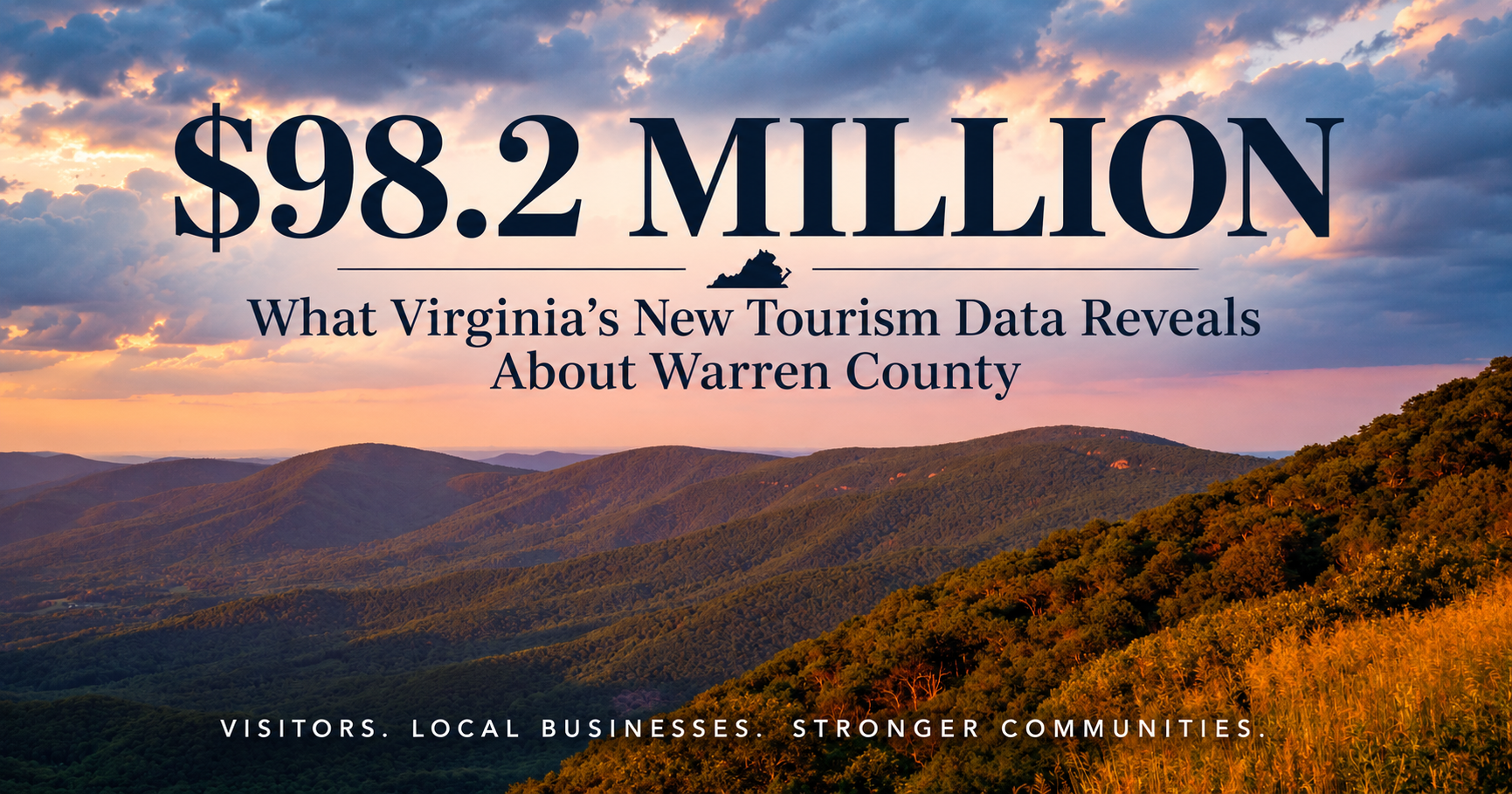
$98.2 Million
What Virginia’s new tourism numbers tell us about Warren County—and why getting visitors here is only half the job
The 2025 Virginia Tourism Visitor Spending data has now been released, giving communities across the Commonwealth a fresh look at the economic impact of tourism in their own backyards. The report tracks how much visitors spent in each locality, where that money was spent, how many jobs tourism supported, and how much tax revenue it generated. For Warren County, the numbers are important not just because they show the size of our tourism economy, but because they also help reveal where we are doing well, where we may be leaving opportunities on the table, and why destination development matters.
$98.2 million.
That is how much visitors spent in Warren County in 2025, according to newly released tourism economic impact data from the Virginia Tourism Corporation and Tourism Economics.
It is a big number.
It supported 841 jobs, generated more than $26 million in labor income, and produced approximately $4.3 million in local tax revenue.
Tourism matters in Warren County.
But buried inside that $98.2 million is a much more important story.
The numbers suggest that Warren County is quite good at giving people a reason to come here.
The question is whether we are doing enough with them once they arrive.
First, the good news
Visitor spending in Warren County increased from approximately $95.9 million in 2024 to $98.2 million in 2025.
That is growth of about 2.45%.
Go back to 2019, before the pandemic, and the story looks even better. Warren County visitor spending was approximately $69.7 million that year.
It has grown roughly 41% since then.
Over the same period, the Shenandoah Valley region grew by about 30%.
So this is not a story about tourism failing in Warren County. Quite the opposite.
Warren County has built a substantial visitor economy, and over the longer term it has grown faster than the Shenandoah Valley as a whole.
But something interesting happened in 2025.
The Valley grew twice as fast as we did
While Warren County visitor spending grew 2.45% last year, visitor spending across the Shenandoah Valley grew approximately 5.08%.
In other words, the region grew at more than twice Warren County's rate.
Some communities grew considerably faster.
Rockingham County grew 11.1%. Waynesboro grew 8.2%. Harrisonburg grew 7.9%. Augusta County grew 7.6%. Staunton grew 7%.
Page County, one of our closest tourism comparisons, grew 4.5%.
Warren County grew 2.45%.
The entire Shenandoah Valley added approximately $84 million in visitor spending in one year.
Warren County captured about $2.35 million of that growth.
That doesn't mean Warren County tourism is in trouble.
It does mean we should be asking why other destinations are currently growing faster.
And when we look deeper into the numbers, we begin to get some clues.
Follow the money
The $98.2 million visitors spent in Warren County wasn't distributed evenly.
Approximately:
$36.5 million went to food and beverage.
$24.3 million went to lodging.
$14.7 million went to recreation.
$14.1 million went to transportation.
$8.6 million went to retail.
Those numbers become much more interesting when we compare them with the Shenandoah Valley.
Food and beverage accounts for about 37.2% of Warren County visitor spending, compared with 33.7% across the Valley.
Recreation accounts for 15% here, compared with 12.1% regionally.
Those are strengths.
Then there is retail.
Retail represents only about 8.7% of Warren County visitor spending.
Across the Shenandoah Valley, it represents approximately 12.8%.
That's a significant difference.
If Warren County's $98.2 million visitor economy had the same retail spending share as the Shenandoah Valley overall, retail visitor spending would be roughly $12.6 million instead of $8.6 million.
That's a difference of approximately $4 million.
That doesn't mean there is literally $4 million sitting on the table waiting for us to pick it up. Tourism economies don't work that neatly.
But it does reveal the scale of the opportunity.
Why is our retail spending so low?
That's the question we should be asking.
And I don't pretend to have a single definitive answer.
Could part of it be that we aren't successfully moving enough visitors into downtown Front Royal?
Possibly.
Think about the geography of our tourism economy.
We have the northern entrance to Shenandoah National Park and Skyline Drive. We have the Shenandoah River. We have hiking, paddling, fishing, camping, cabins and some of the most beautiful outdoor assets in Virginia.
Those things bring people here.
The spending data seems to confirm it.
In fact, recreation spending in Warren County has increased approximately 67% since 2019, far faster than recreation spending across the Shenandoah Valley as a whole.
Getting people to Warren County may not be our biggest problem.
The challenge may be what happens next.
Does the visitor coming out of Shenandoah National Park know there is a downtown worth exploring?
Do we give that person a reason to turn toward Main Street?
Can they easily figure out where to park?
Do they know what shops, restaurants and attractions are there?
Do we give them something compelling to do for another three hours?
Can we turn an afternoon visit into dinner?
Can we turn dinner into an overnight stay?
Can we turn one night into two?
Those questions are destination development.
Look 25 miles down the road
Page County offers an interesting comparison.
Visitors spent approximately $109.6 million in Page County in 2025 compared with Warren County's $98.2 million.
But the way they spent that money was very different.
Warren County generated approximately $24.3 million in lodging spending.
Page County generated approximately $42.5 million.
That's roughly 75% more.
One obvious difference is lodging inventory.
Page County has developed a massive short-term rental economy, with roughly 800 short-term rentals compared with around 300 in Warren County.
More places to stay create more opportunities for overnight visitors.
And overnight visitors behave differently from day visitors.
They need dinner.
Then breakfast.
Maybe coffee.
They have another morning to fill.
They may shop.
They may visit another attraction.
They may stay for another night.
The goal shouldn't necessarily be to replicate Page County's short-term-rental model. Every community has to decide what kind of destination it wants to be, and short-term rentals bring legitimate land-use and community questions of their own.
But the economic lesson is difficult to ignore:
Length of stay matters.
Page County also gets far more retail spending
The Page County comparison gets even more interesting.
Visitor retail spending in Warren County was approximately $8.6 million.
In Page County it was approximately $19.3 million.
That's more than twice Warren County's retail spending.
Yet Warren County actually generated far more food-and-beverage spending—about $36.5 million compared with Page's $16.6 million.
So visitors clearly spend money here.
The question is why our visitor economy produces so much less retail activity.
That's a question worth answering.
Not because retail is more important than restaurants, lodging or recreation.
It's because every dollar a visitor spends locally moves through our economy.
It supports a business. It helps employ someone. It helps occupy a storefront. It generates tax revenue. And some portion of it gets spent again locally.
This is why tourism and destination development are not the same thing
For years, communities have often thought about tourism primarily as marketing.
Buy advertisements.
Print brochures.
Post on social media.
Attend travel shows.
Tell people to come visit.
Those things still have a role.
But destination development asks a different question:
What happens after the marketing works?
If we spend money convincing someone to come to Warren County and that visitor drives Skyline Drive, buys lunch and leaves, we have created economic activity.
That's good.
But what if we could get that same visitor to drive Skyline Drive, explore downtown Front Royal, visit two shops, have lunch, take a river trip, stay overnight, have dinner, buy coffee the next morning and visit another attraction before leaving?
We didn't necessarily need another visitor.
We created considerably more economic impact from the visitor we already had.
That is destination development.
The $98.2 million should be the beginning of the conversation
Warren County's tourism economy generated approximately $4.3 million in local tax revenue in 2025.
That alone should make destination development an economic-development priority.
But the new numbers give us something even more valuable.
They show us where some of the opportunities may be.
Our recreation economy is strong.
Our food-and-beverage economy is strong.
People are coming here.
But our lodging share is slightly below the regional average, our retail share is substantially below it, and our overall visitor-spending growth fell behind the Shenandoah Valley in 2025.
Those aren't reasons for pessimism.
They're a roadmap.
What would success look like?
Perhaps the next phase of Warren County tourism shouldn't simply be measured by how many people we reach with advertising or how many people enter the county.
Maybe we should begin asking:
How long are they staying?
How many become overnight visitors?
How many visit downtown Front Royal?
How much are they spending with local retailers?
How many businesses are benefiting from tourism?
How effectively are we connecting Shenandoah National Park, Skyline Drive, the Shenandoah River, downtown Front Royal and the rest of Warren County into one visitor experience?
And perhaps most importantly:
How much economic value are we creating from every visitor who is already here?
That requires wayfinding.
It requires better connections between our tourism assets.
It requires itineraries that give visitors reasons to stay.
It requires new experiences and tourism products.
It requires cooperation among lodging properties, restaurants, retailers, attractions, recreation businesses, the Town of Front Royal and Warren County.
It requires looking at downtown not as something separate from tourism, but as part of the destination.
And it requires understanding that destination development is economic development.
$98.2 million—and what comes next
We should be proud that visitors spent nearly $100 million in Warren County last year.
But we shouldn't look at $98.2 million and simply congratulate ourselves.
We should look at it and ask what the number could become.
$105 million?
$110 million?
$120 million?
More importantly, how much of that growth can support locally owned businesses, create jobs, fill storefronts, increase lodging demand and generate additional tax revenue without asking local residents to shoulder that burden?
Warren County already possesses something many destinations spend decades trying to create.
We have a reason for people to come.
The mountains are here.
The river is here.
Skyline Drive is here.
Shenandoah National Park is here.
Front Royal is here.
And the visitors are already coming.
Our next opportunity is connecting those pieces well enough that visitors don't simply pass through Warren County.
We need to give them reasons to experience it.
More from Scott Turnmeyer
I write about photography, business, mindset, bowling, and the bigger questions that don’t always have easy answers. You can explore more articles, photography, and projects here:
Blog Home
About Scott Turnmeyer
Fine Art Photography
Photography Workshops & Experiences
Digital Consulting