
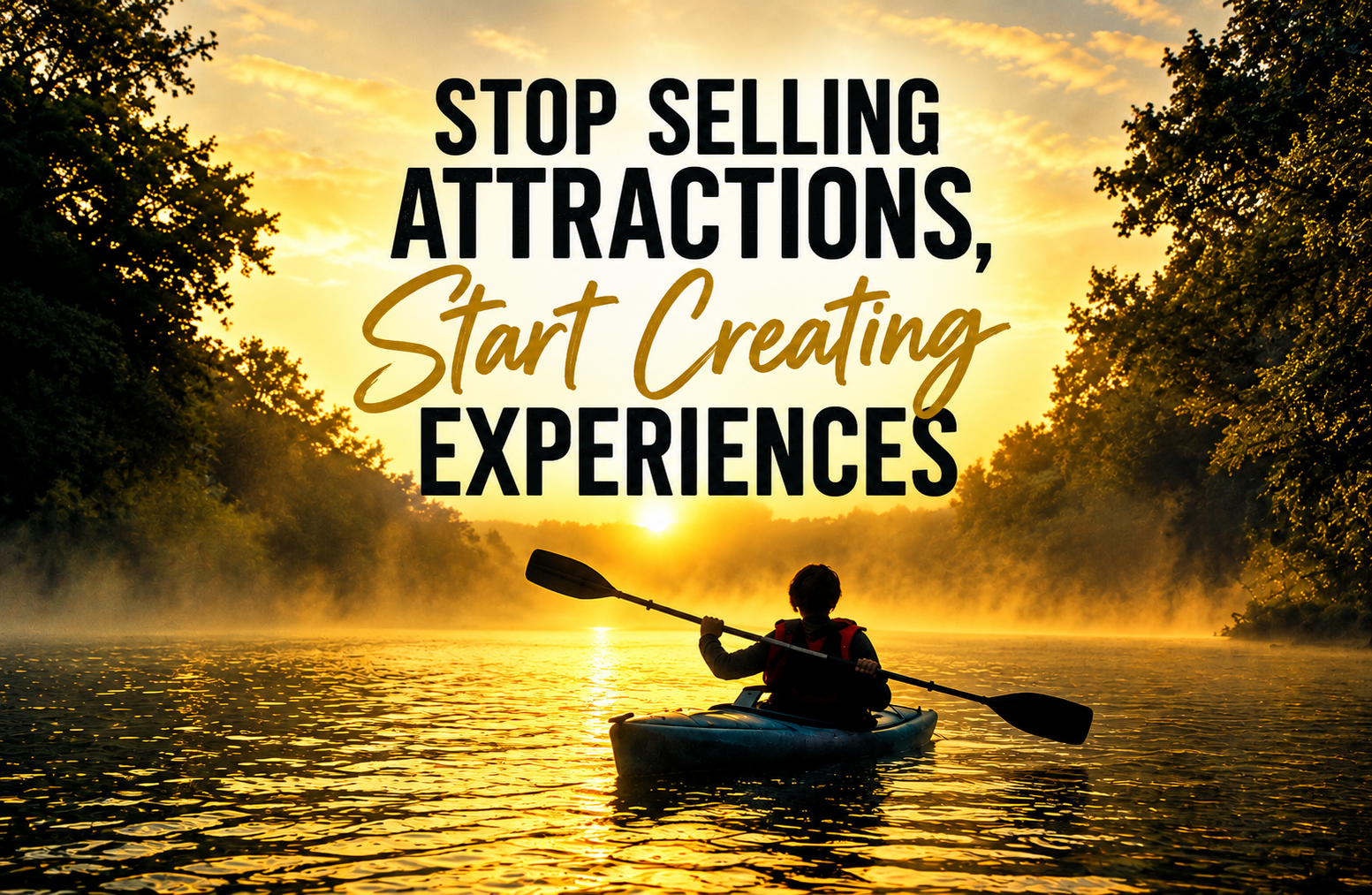
Stop Selling Attractions. Start Creating Experiences.
For decades, tourism marketing has followed a pretty simple formula.
Make a list of the things people can do.
Visit this museum. Hike this trail. Tour this historic site. Eat at this restaurant. Visit this winery. Shop downtown.
Then put all of those things on a website, print them in a visitor guide, run some ads and call it tourism marketing.
There’s just one problem.
People don’t travel for lists. They travel for experiences.
And there is a very big difference between the two.
Nobody Remembers the Checklist
Think about the trips you remember most.
You probably don't remember every attraction you visited.
You remember moments.
You remember sitting outside a restaurant on a warm evening while music played down the street.
You remember turning a corner on a trail and suddenly seeing a view that stopped you in your tracks.
You remember the little shop you wandered into where the owner spent twenty minutes telling you about the town.
You remember the brewery where you ended up talking with another couple for two hours.
You remember the unexpected things.
Those moments become the stories we tell when we get home.
And those stories are incredibly important because stories are how destinations grow.
Someone comes home and says:
"You have to go there."
That sentence might be one of the most powerful forms of tourism marketing that exists.
But destinations can't manufacture that sentence with a list of attractions.
They have to create the conditions for memorable experiences.
The Destination Is the Product
One of the biggest mistakes communities make with tourism is thinking individual attractions are the product.
They aren't.
The destination itself is the product.
A visitor doesn't experience a restaurant independently from everything around it.
They experience the drive into town.
They experience parking.
They experience the sidewalks.
They experience the person behind the counter.
They experience whether they can figure out where to go next.
They experience the coffee shop, the brewery, the trail, the hotel, the public restroom and the store they discovered while walking back to their car.
All of those individual interactions combine into one thing:
Their perception of your destination.
That means tourism development can't simply be about getting more attractions.
It has to be about connecting the pieces that already exist.
Attractions Give People a Reason to Come. Experiences Give Them a Reason to Stay.
An attraction might convince someone to visit your community.
But what happens after they arrive determines the economic impact of that visit.
Imagine someone comes to your area specifically to hike a popular trail.
If your tourism strategy ends with telling them where the trail is, you've missed most of the opportunity.
What happens after the hike?
Where should they eat?
Where can they grab a local beer?
Is there a downtown nearby worth exploring?
Are there shops they would enjoy?
Is there somewhere interesting to watch the sunset?
Is there something happening that evening?
What should they do tomorrow morning?
The goal isn't simply to generate a visit.
The goal is to expand the experience.
A three-hour visit can become an entire day.
A day trip can become an overnight stay.
An overnight stay can become a weekend.
And every additional hour a visitor spends in the destination creates additional opportunities for local businesses.
That is destination development.
Stop Organizing Tourism Around Categories
Most tourism websites are organized like filing cabinets.
Things to Do.
Places to Eat.
Places to Stay.
Shopping.
Events.
Outdoor Recreation.
Those categories make sense to the people managing the website.
But visitors don't necessarily think that way.
Visitors think in experiences.
"What should we do this afternoon?"
"We're coming for a romantic weekend. What should we do?"
"Where can we take the kids?"
"We have four hours before dinner."
"It's raining. Now what?"
"We want to spend the day outdoors and finish somewhere with a great meal."
Those are very different questions.
Instead of simply presenting inventory, destinations should help visitors build experiences.
Imagine replacing a generic list of attractions with something like:
A Perfect Fall Day
Start with coffee downtown.
Drive to a scenic overlook.
Spend the morning hiking.
Come back into town for lunch.
Browse local shops during the afternoon.
Visit a brewery or winery.
Finish the evening with dinner and live music.
Now you're not selling seven separate businesses or attractions.
You're selling a day someone can imagine themselves experiencing.
That's much more powerful.
The Spaces Between Attractions Matter
Some of the most important parts of a visitor experience aren't attractions at all.
They're the spaces between them.
Wayfinding.
Parking.
Sidewalks.
Public spaces.
Landscaping.
Benches.
Lighting.
Public restrooms.
Signage.
Internet access.
Even something as simple as knowing where to go next.
These things aren't particularly exciting to advertise.
But they can determine whether someone spends two hours in your community or eight.
A visitor who parks, visits one attraction and leaves has a very different economic impact from someone who parks, explores downtown, shops, eats lunch, visits another attraction and stays for dinner.
The difference may have very little to do with marketing.
It may simply be that the second visitor found it easy and enjoyable to explore.
Great Destinations Create Accidental Discovery
Some of the best travel experiences aren't planned.
You notice a sign.
You hear music.
You see people gathered somewhere.
You walk into a store you didn't know existed.
You discover a restaurant while exploring downtown.
These moments feel spontaneous to the visitor.
But good destination development can make spontaneous discovery much more likely.
Walkable districts create discovery.
Good wayfinding creates discovery.
Public spaces create discovery.
Events create discovery.
Connections between businesses create discovery.
Digital tools can create discovery.
The goal isn't to control every visitor's itinerary.
It's to make the destination easy to explore.
Businesses Have to See Themselves as Part of the Experience
This also requires a shift in how local businesses think about tourism.
A restaurant isn't just selling dinner.
A retailer isn't just selling merchandise.
A brewery isn't just selling beer.
A hotel isn't just selling a room.
Each business is helping create the visitor's impression of the destination.
That creates opportunities for collaboration.
A hotel can recommend a local coffee shop.
A brewery can recommend nearby restaurants.
A retailer can tell visitors about tonight's event.
An attraction can suggest what visitors should do afterward.
Instead of dozens of businesses individually competing for visitors, the destination begins functioning like an ecosystem.
And when that happens, everyone has an opportunity to benefit.
Marketing Should Start With the Experience
This changes tourism marketing too.
Instead of asking:
"What attractions should we promote?"
Start asking:
"What experiences can someone have here that they can't have somewhere else?"
Then build the marketing around those experiences.
Maybe it's watching the sunrise over the mountains and having breakfast downtown afterward.
Maybe it's spending the morning on the river and the afternoon exploring local shops.
Maybe it's a weekend built around history, food and small-town architecture.
Maybe it's hiking during peak fall color followed by a local brewery and live music.
Those experiences are what differentiate destinations.
Because almost every community has restaurants.
Almost every community has shops.
Many communities have trails, museums, breweries or historic sites.
The competitive advantage comes from how those pieces fit together.
From Tourism Marketing to Destination Development
This is ultimately the difference between tourism marketing and destination development.
Tourism marketing asks:
How do we get people here?
Destination development asks:
What happens when they arrive?
Both matter.
But marketing without development eventually hits a ceiling.
You can spend more money advertising.
You can generate more impressions.
You can produce better videos.
You can build a prettier website.
But if the visitor experience doesn't improve, eventually you're just sending more people into the same experience.
The better strategy is to work on both sides.
Create demand.
Then create an experience worthy of that demand.
Give Them a Story to Take Home
The most successful destinations understand something very simple.
Visitors don't go home talking about tourism strategies.
They don't talk about marketing campaigns.
They don't talk about visitor guides.
They talk about what happened.
They talk about the restaurant they discovered.
The view they weren't expecting.
The shop owner they met.
The trail they hiked.
The music they heard.
The place they stumbled across.
The feeling they had while they were there.
Those stories become recommendations.
Recommendations become future visitors.
And future visitors create economic activity throughout the community.
So maybe the question communities should be asking isn't:
"What attractions do we have?"
Maybe the better question is:
"What stories will people tell after they leave?"
Build the destination around that question.
Stop selling attractions.
Start creating experiences.
More from Scott Turnmeyer
I write about photography, business, mindset, bowling, and the bigger questions that don’t always have easy answers. You can explore more articles, photography, and projects here:
Blog Home
About Scott Turnmeyer
Fine Art Photography
Photography Workshops & Experiences
Digital Consulting