
The Future of Destination Websites
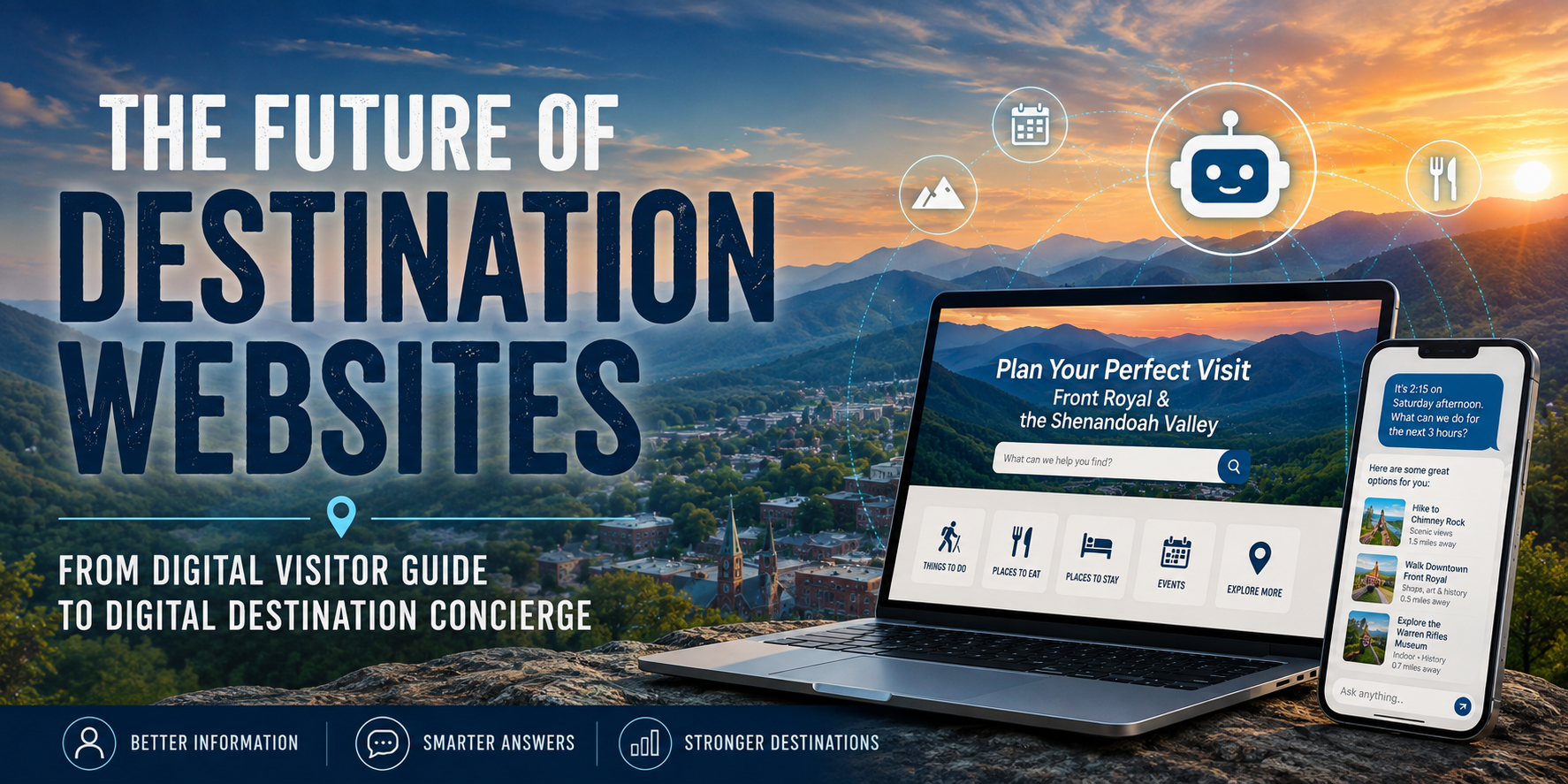
For years, the destination website has been one of the centerpieces of tourism marketing.
Visit our website. Browse our attractions. Find a restaurant. Look for a hotel. Check the events calendar. Download a visitor guide.
The basic idea was simple: get someone to the website and help them plan their trip.
I don't think destination websites are going away.
But I do think their role is about to change dramatically.
Because increasingly, travelers don't want to search through dozens of webpages to assemble a trip themselves.
They want to ask a question.
“Where can we go for a three-day weekend within two hours of Washington, D.C., with hiking, a walkable downtown and good restaurants?”
And they expect an answer.
Not ten links.
Not a homepage.
An answer.
The Website May No Longer Be the Front Door
For a long time, the digital travel-planning journey was fairly predictable.
Someone searched Google for a destination or an idea. Search results sent them to a tourism website. From there, they clicked through attractions, restaurants, lodging and events.
Social media changed the discovery part of that journey, but we were still usually trying to drive people somewhere else.
Visit the website.
AI is beginning to change that.
Travelers can increasingly ask conversational tools where they should go, what they should do and even how they should structure their trip.
That means someone considering a visit to the Shenandoah Valley may receive recommendations about Front Royal, Skyline Drive, local restaurants, hiking trails and places to stay without ever beginning at a destination website.
At first, that sounds like bad news for destination websites.
I actually think it makes them more important.
Just in a different way.
The Website Becomes the Source
AI needs information to answer those questions.
What attractions are available?
Where are they?
When are they open?
Which trails are appropriate for families?
What's happening this weekend?
What restaurants are near a particular attraction?
Where can someone park?
What can visitors do when it rains?
The better information available about a destination, the better chance that destination has of appearing in those answers.
That means the destination website of the future can't simply be an attractive online brochure.
It needs to become a trusted source of destination information.
Accurate. Specific. Current. Useful.
Instead of writing generic marketing copy about an “unforgettable outdoor adventure,” tell people what the experience actually is.
How long does it take?
How difficult is it?
Where do you park?
Is there an admission fee?
Can you bring a dog?
Is it appropriate for young children?
What else is nearby?
That's useful to a person.
It's also useful to the systems increasingly helping that person plan a trip.
We Need to Answer the Questions Visitors Actually Ask
This also means thinking differently about destination content.
Most tourism websites are organized into familiar categories:
Things to Do.
Places to Stay.
Restaurants.
Shopping.
Events.
There's nothing wrong with those categories.
But that's often not how a visitor thinks.
A visitor asks:
What can we do with our kids this afternoon?
Where can we hike if we only have two hours?
What can we do if it rains?
Where should we eat after leaving Shenandoah National Park?
What is open Sunday evening?
Where can we park downtown?
Those questions should influence the content we create.
The goal shouldn't simply be to have a page for every business and attraction.
The goal should be to understand the visitor well enough to answer the questions they're going to have.
From Website to Digital Concierge
This is where I think things get really interesting.
Imagine arriving in Front Royal on a Saturday afternoon.
Instead of scrolling through pages of attractions, you simply ask:
“It's 2:15. We have about three hours before dinner. What should we do?”
A truly useful destination platform could consider where you are, what's nearby, what's open and what's happening that day.
Maybe there's a downtown event starting at 3:00.
Maybe you have enough time for a short hike.
Maybe rain is coming and an indoor attraction makes more sense.
Maybe you've already indicated that you're traveling with young children.
Now the destination website isn't simply giving you information.
It's helping you experience the destination.
That's a completely different role.
The website starts becoming a digital destination concierge.
And unlike the traditional visitor center, that concierge is available before the trip, during the trip and potentially anywhere in the destination.
This Matters for Local Businesses
There's another important piece of this transformation.
A destination isn't just its major attractions.
It's the independent restaurant someone discovers after a hike.
The shop they wander into downtown.
The farm they visit on the way home.
The museum they didn't know existed.
The local event happening that weekend.
The destination organization should want all of those things to be discoverable.
If someone asks:
“Where can I find an independent gift shop near Shenandoah National Park?”
or:
“What's a locally owned restaurant near downtown Front Royal?”
our goal should be for good local answers to surface.
That means helping businesses become part of the destination's digital information ecosystem may become just as important as putting them in a visitor guide.
Website Traffic May Matter Less
This change also challenges one of the ways we've traditionally measured digital tourism marketing.
Website traffic.
Imagine someone asks an AI assistant for a weekend destination.
It recommends Front Royal.
The traveler asks what to do and receives recommendations for a hike, three local businesses and an event.
They book a room, come to town and spend hundreds of dollars.
But they never visit the official destination website.
Was the destination's digital strategy unsuccessful?
Of course not.
The objective was never supposed to be website traffic.
The objective is getting the right visitor to the destination and helping that visitor have an experience that produces economic impact and, hopefully, makes them want to return.
Pageviews are a measurement.
They're not the mission.
The Destination Website Isn't Dying
I don't think we're approaching the end of destination websites.
I think we're approaching the next version of them.
The old destination website was essentially a digital visitor guide.
Today's better websites are becoming trip-planning tools.
The destination website of the future may become something much bigger:
the information infrastructure for the destination.
It can feed information to travelers, search engines, AI assistants, maps, visitor centers, digital signage and technologies we haven't developed yet.
Some visitors will still browse the website.
Others may talk to it.
And some may never see it at all, even while information originating from it helps shape their trip.
That's okay.
Because our job isn't to get people to a homepage.
It's to connect people with a place.
And the destination organizations that understand that distinction are going to be much better prepared for whatever comes next.
More from Scott Turnmeyer
I write about photography, business, mindset, bowling, and the bigger questions that don’t always have easy answers. You can explore more articles, photography, and projects here:
Blog Home
About Scott Turnmeyer
Fine Art Photography
Photography Workshops & Experiences
Digital Consulting