
Why Do the Blue Ridge Mountains Look Blue?
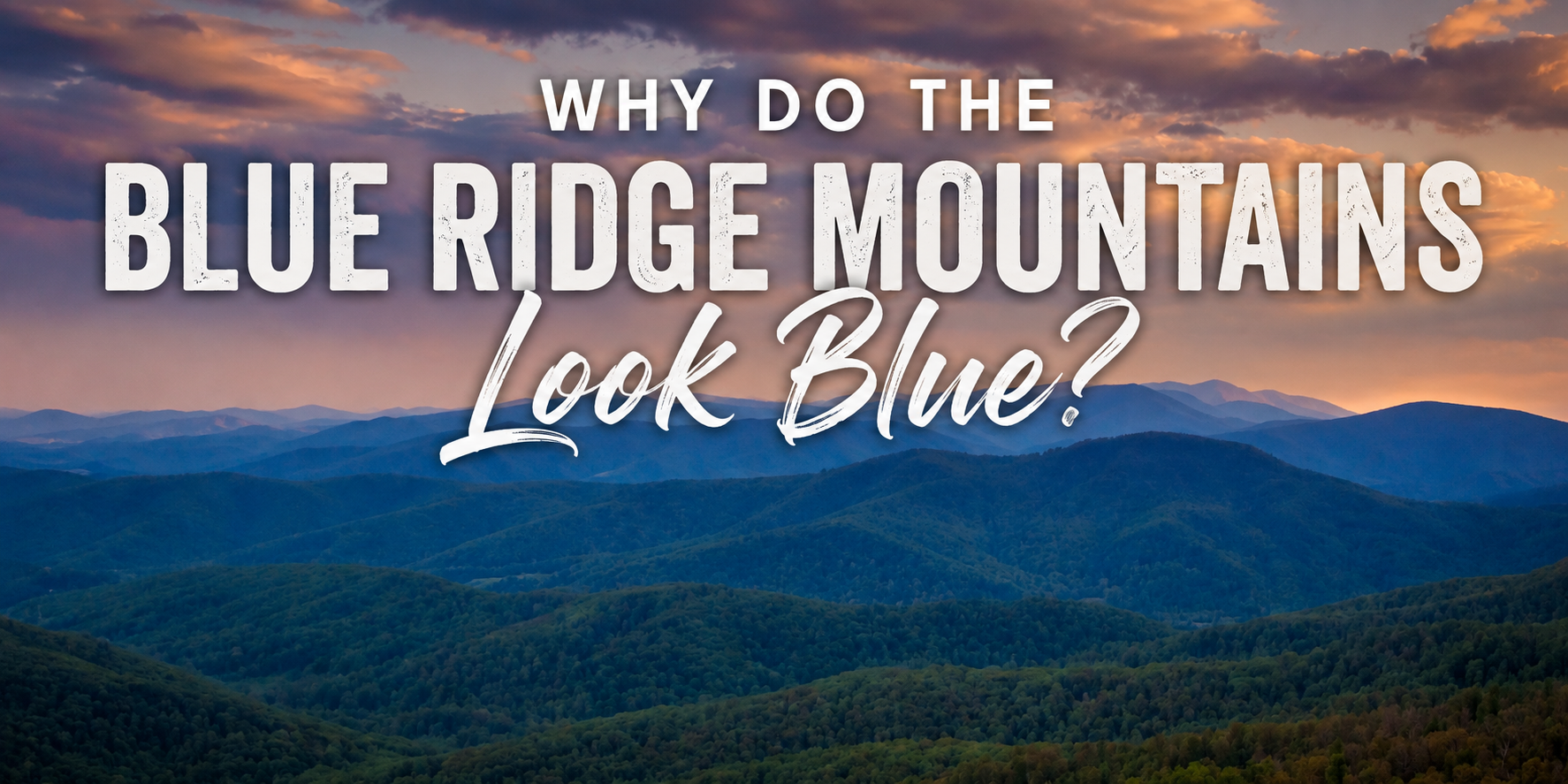
If you've ever stood at an overlook along Skyline Drive, looked west from Front Royal, or watched the mountains fade into the distance across the Shenandoah Valley, you've probably noticed something distinctive about the Blue Ridge Mountains.
They're actually blue.
Not just occasionally. Not just at sunrise or sunset. Even in the middle of a clear day, distant ridgelines often have an unmistakable blue or blue-gray appearance.
It's such a defining feature of the landscape that an entire mountain range was named for it.
But mountains aren't blue. The rocks aren't blue. The trees covering them certainly aren't blue.
So why do the Blue Ridge Mountains look blue?
The answer involves trees, sunlight and a little bit of atmospheric science.
The Trees Are Part of the Answer
The Blue Ridge Mountains are covered by vast forests containing millions upon millions of trees.
Those trees release naturally occurring organic compounds into the atmosphere. One of the most important is a compound called isoprene.
You can't see isoprene coming from a tree, but forests release enormous quantities of it, particularly during warm weather.
Once these compounds enter the atmosphere, they react with other substances in the air and can contribute to the formation of tiny airborne particles called aerosols.
With millions of acres of forest producing these compounds, those particles can create a natural haze over the mountains.
And that's where sunlight comes into the picture.
Why the Haze Looks Blue
Sunlight may look white to us, but it contains all of the colors of the visible spectrum.
As sunlight travels through the atmosphere, it interacts with molecules and tiny particles. Different wavelengths of light behave differently during those interactions.
Blue light has a relatively short wavelength and is scattered more readily than longer wavelengths such as red.
It's the same basic reason the sky appears blue.
When you're looking across miles of forested mountains, you're not simply seeing the trees and rocks on the distant ridge. You're also looking through miles of atmosphere containing gases, moisture and microscopic particles.
That atmospheric scattering adds a blue cast to the distant landscape.
The farther away the ridge, the more atmosphere you're looking through.
That's why the mountains often seem to transition from dark green nearby to blue-gray in the distance.
Look across several layers of ridges from a Blue Ridge overlook and you can often see the effect beautifully: each successive ridge becomes lighter, hazier and bluer until the mountains eventually seem to disappear into the sky.
Is the Blue Haze Pollution?
This is where the story gets a little more complicated.
The haze associated with the Blue Ridge Mountains has a natural component. Forests were releasing organic compounds long before highways, factories or modern cities existed.
But that doesn't mean all haze over the mountains is natural.
Human-generated air pollution can also contribute particles and chemicals to the atmosphere, increasing haze and reducing visibility.
So the beautiful blue appearance that helped give the Blue Ridge its name shouldn't be confused with every kind of haze we see today.
There is a natural atmospheric phenomenon at work here, but modern air quality can affect how clearly we're able to see across the mountains.
On exceptionally clear days, distant ridges can appear remarkably sharp. On hazier days, those same mountains may nearly disappear.
Why Are They Called the Blue Ridge Mountains?
The name makes considerably more sense once you've seen the mountains from a distance.
The Blue Ridge is part of the larger Appalachian Mountain system and stretches for hundreds of miles through the eastern United States.
From a distance, the forested ridges frequently take on the distinctive bluish appearance that became associated with the range.
Here in Virginia, the Blue Ridge forms one of the defining features of the landscape.
For Front Royal, it's impossible to separate the mountains from the identity of the area.
Front Royal sits near the northern entrance to Shenandoah National Park and Skyline Drive, with the Blue Ridge rising dramatically just outside town.
They're part of the backdrop to everyday life here.
And depending on the weather, season and time of day, they never look quite the same twice.
Why Do Some Days Look Bluer Than Others?
If you spend enough time around the Blue Ridge, you'll notice that the color and visibility of the mountains can change dramatically.
Humidity plays a major role.
Water vapor and tiny suspended droplets affect the way light travels through the atmosphere. On humid summer days, the mountains may appear especially hazy and blue, with distant ridges fading quickly.
After a cold front passes through, however, the air can become much clearer.
Those are the days when it feels as though you can see forever.
The angle of the sun matters too. Morning and evening light can dramatically change the color of the landscape, while clouds and atmospheric conditions can make the same ridge appear deep blue one day and almost gray the next.
Season matters as well.
Summer brings dense foliage, heat and humidity. Fall transforms the mountains into reds, oranges and yellows at close range while distant ridges can still retain their blue cast. Winter strips away much of the foliage and frequently brings clearer, drier air.
That's one of the things I love about photographing the Blue Ridge.
You can return to exactly the same overlook dozens of times and never really photograph exactly the same scene.
The Blue Ridge Is a Perfect Example of How Nature Works at Scale
One tree releasing an invisible organic compound isn't particularly dramatic.
Neither is a single molecule scattering sunlight.
But multiply those processes across millions of trees, thousands of square miles of forest and miles of atmosphere, and the result becomes one of the most recognizable landscapes in America.
That's what makes the explanation so interesting.
The Blue Ridge Mountains don't look blue because the mountains themselves are blue.
They look blue because you're seeing an enormous landscape through an atmosphere influenced, in part, by the forest itself.
The trees help create the haze.
The atmosphere scatters the light.
Your eyes see blue.
It's a reminder that sometimes the most beautiful parts of a landscape aren't created by one thing at all.
They're created by everything working together.
And the next time you're standing at an overlook on Skyline Drive watching layer after layer of blue mountains disappear toward the horizon, you'll know you're not just looking at the Blue Ridge.
You're seeing part of the process that helped give these mountains their name.
More from Scott Turnmeyer
I write about photography, business, mindset, bowling, and the bigger questions that don’t always have easy answers. You can explore more articles, photography, and projects here:
Blog Home
About Scott Turnmeyer
Fine Art Photography
Photography Workshops & Experiences
Digital Consulting