
Best Week for Peak Fall Color in Shenandoah and Virginia’s Blue Ridge
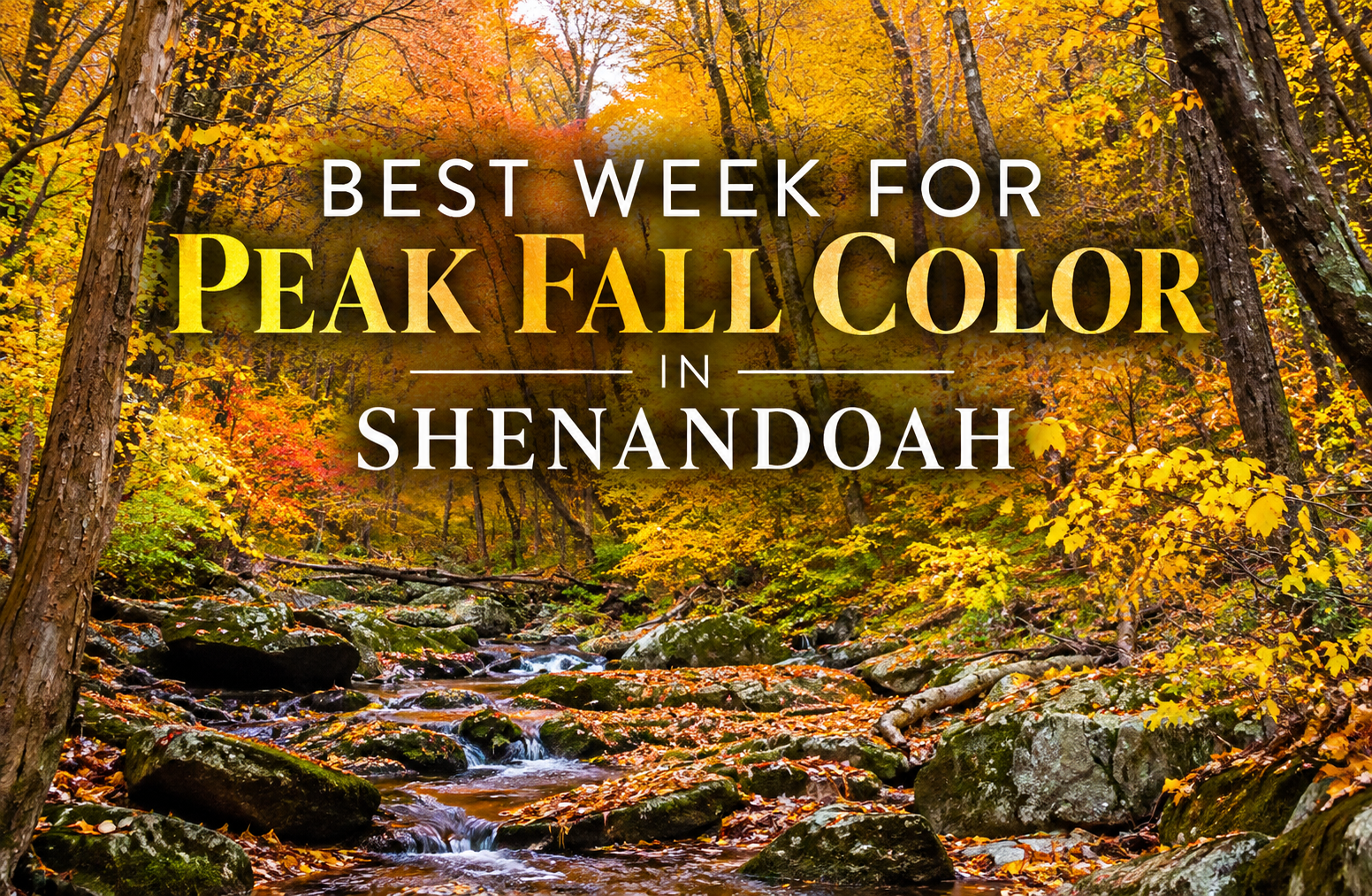
Every fall, I hear some version of the same question:
“When is the best week to see peak fall color?”
Everyone wants the date.
They want to book the hotel, plan the drive, schedule the hike, charge the camera batteries and arrive on the exact day when the mountains explode into red, orange and gold.
I wish it were that easy.
There is no single peak fall color date in the Shenandoah Valley or Virginia’s Blue Ridge.
But there is a window I would choose if I had to pick just one.
If I Had to Pick One Week
If you're planning a trip to Shenandoah National Park or the northern Shenandoah Valley and can choose only one week, I would generally target:
October 15–22.
That's not a guarantee. Mother Nature doesn't use Google Calendar.
But historically, the middle to latter part of October gives you an excellent chance of finding significant color somewhere in the region.
The National Park Service says Shenandoah's most brilliant fall color has historically tended to occur around the second or third week of October. The Virginia Department of Forestry puts Virginia's general peak-color window between October 10 and October 31.
But there's something much more important to understand.
Peak color isn't a date. It's a movement.
Fall Color Moves Down the Mountain
This is probably the biggest misconception about fall foliage in the Blue Ridge.
People imagine the entire region changing color at once.
It doesn't.
Color generally begins at the highest elevations and works its way down the mountains toward the valleys. Virginia's enormous variation in elevation is one reason we get such a long fall foliage season.
That creates an interesting situation in places like Shenandoah National Park.
You might drive along Skyline Drive and find trees near the highest elevations already past peak.
Then descend several thousand feet toward the Shenandoah Valley and find spectacular color.
A week later, the mountaintops may be increasingly bare while the valleys below are glowing orange and gold.
That's why asking:
“When does Shenandoah peak?”
isn't quite the right question.
A better question is:
“Where will peak color be when I'm there?”
That changes how you plan a fall trip.
Why Skyline Drive Doesn't Have One Peak Day
Shenandoah National Park stretches for more than 100 miles along the Blue Ridge and contains substantial changes in elevation.
The National Park Service specifically cautions that color can vary dramatically throughout the park because of those differences in elevation.
That's actually good news for visitors.
It means you don't necessarily have to perfectly predict peak foliage.
You can chase it.
If higher elevations are past peak, head lower.
If the valleys are still mostly green, head higher.
And if you happen to arrive when the color is moving through the middle elevations?
That's when the Blue Ridge can become spectacular.
A Rough Fall Color Timeline
Every year is different, but I think about the season roughly like this.
Late September to early October:
The first noticeable changes begin appearing at higher elevations. Most of the valleys are still predominantly green.
Early to mid-October:
Higher elevations begin developing substantial color while changes become increasingly visible farther down the mountains.
Mid to late October:
This is the window I would target if I were traveling specifically for fall color. Depending on elevation and that year's weather, you can often find excellent foliage somewhere between Skyline Drive and the valley floor.
Late October into early November:
Higher elevations may be past peak, but beautiful color can remain at lower elevations and farther east.
Virginia's fall color season continues progressively eastward, with the state's highest mountains changing before lower elevations and the Coastal Plain.
In other words, don't automatically cancel a late-October trip because someone tells you that “the mountains already peaked.”
You may simply need to change elevation.
Weather Can Change Everything
This is where predicting fall foliage gets complicated.
Temperature and rainfall both influence the timing and quality of fall color, which is why historical averages should be treated as guides rather than appointments.
The weather during autumn matters too.
A perfectly timed foliage trip can be transformed by a storm that strips leaves from exposed ridges.
Meanwhile, protected valleys may still look incredible.
That's another reason I wouldn't build an entire trip around one overlook or one section of Skyline Drive.
Give yourself options.
Don't Just Look From the Top
This is one of my biggest recommendations for photographing or simply experiencing fall in the Shenandoah Valley.
Get off the ridge.
Skyline Drive is spectacular, and there's a reason people travel from all over the country to see it.
But some of my favorite fall scenes happen below the mountains.
A winding country road beneath a canopy of yellow leaves.
Morning fog sitting over the Shenandoah River.
A farm with the Blue Ridge glowing behind it.
A small town framed by autumn color.
A trail following a creek through the woods.
Sometimes the best view isn't looking from the mountain.
It's looking at the mountain.
The Time of Day Matters Too
Finding great fall color is only half the equation.
Light changes everything.
Midday sunlight can flatten a beautiful landscape. Early morning and late afternoon can transform the same scene.
For photography, I especially love mornings during fall.
Cool nights can produce fog along rivers and in valleys. When that fog begins lifting and sunlight starts breaking through it, an ordinary landscape can become extraordinary.
Late afternoon can be equally beautiful as warm light hits the Blue Ridge.
That's why I wouldn't plan a fall-color trip around simply driving from overlook to overlook at noon.
Give yourself a sunrise.
Give yourself a sunset.
And give yourself enough time to stop when something catches your eye.
Want Fewer Crowds? Go During the Week.
There's another variable people sometimes forget when choosing the “best” time for fall foliage:
Everyone else wants to see it too.
The National Park Service warns that fall weekends bring large crowds to Shenandoah.
If your schedule allows it, come Monday through Thursday.
You'll still encounter visitors during peak foliage, but avoiding the busiest weekends can make a tremendous difference.
And if you're photographing landscapes, you'll probably appreciate having a little more room anyway.
Don't Try to Time a Single Perfect Day
This is probably the most important advice I can give.
Don't obsess over finding the mythical perfect peak day.
Instead, give yourself a window.
If possible, spend several days exploring different elevations.
Start high.
Drive low.
Explore the valleys.
Watch the weather.
Check current foliage reports.
And be willing to change your plans.
Shenandoah National Park publishes fall-color updates during the season, and Virginia agencies also track foliage progression around the Commonwealth. Those current observations become much more useful than historical averages once you're within a week or two of your trip.
So, What Is the Best Week for Peak Fall Color?
If you make me circle one week on the calendar for Shenandoah National Park and the northern Shenandoah Valley, I'm choosing roughly:
October 15–22
But I'm writing that in pencil.
Some years it will be earlier.
Some years it will be later.
And depending on elevation, you can find completely different stages of fall within a relatively short drive.
That's part of what makes autumn in the Blue Ridge so special.
There isn't one moment when someone flips a switch and the mountains suddenly become orange.
The season slowly rolls across the landscape.
It begins along the highest ridges.
Then it works its way down the mountains.
Eventually it reaches the valleys.
And for a few weeks every autumn, if you're willing to explore a little, there's almost always somewhere beautiful to find.
Don't chase a date.
Chase the color.
More from Scott Turnmeyer
I write about photography, business, mindset, bowling, and the bigger questions that don’t always have easy answers. You can explore more articles, photography, and projects here:
Blog Home
About Scott Turnmeyer
Fine Art Photography
Photography Workshops & Experiences
Digital Consulting