
Digital Wayfinding Is Here
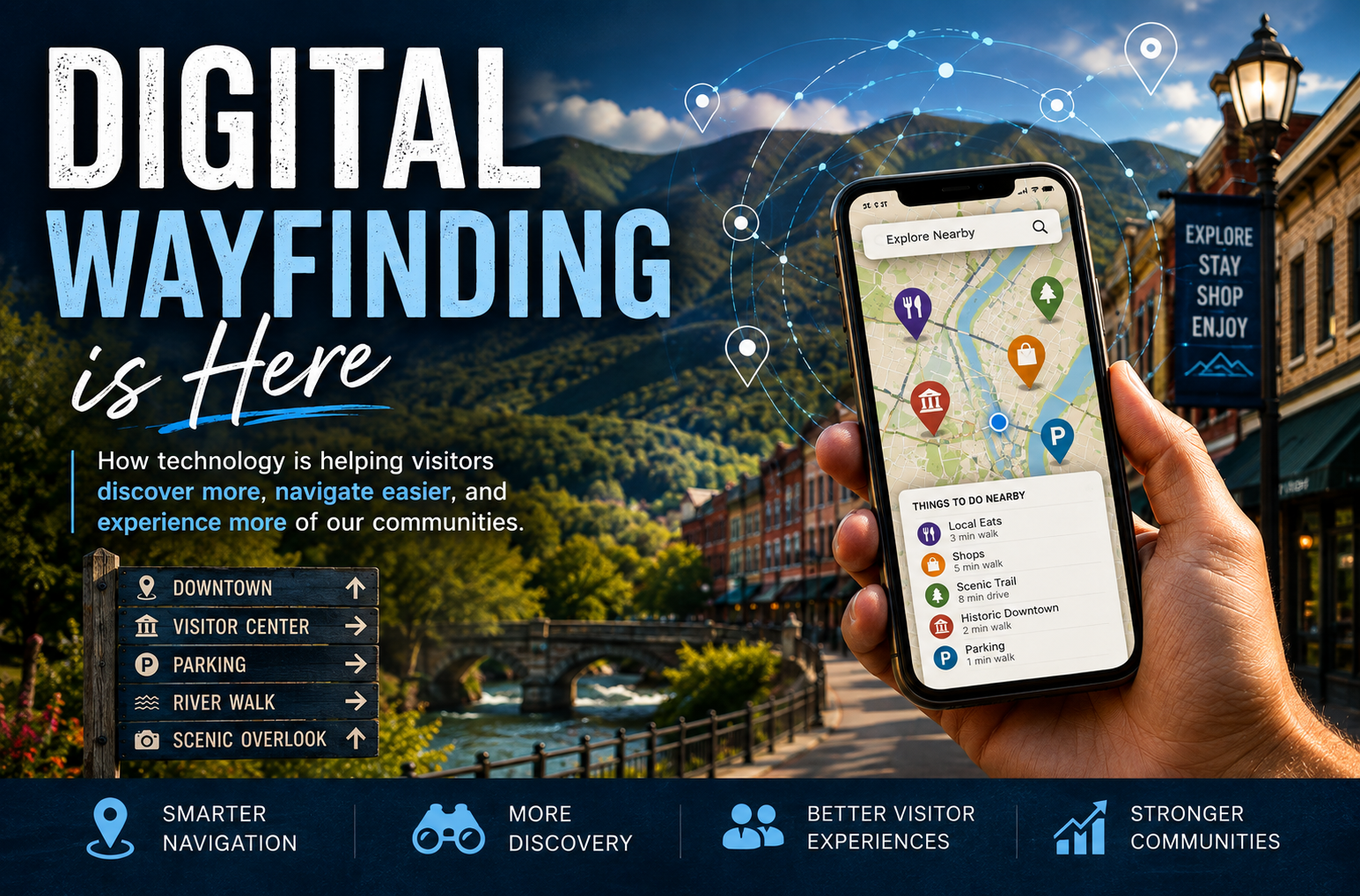
For decades, communities have thought about wayfinding in terms of signs.
Welcome signs. Directional signs. Parking signs. Maps mounted to kiosks. Brown attraction signs along the highway.
Those things still matter.
But today, one of the most important wayfinding systems in any destination is already in the visitor's hand.
Their phone.
Before visitors ever see one of our directional signs, there is a good chance they have already asked Google where to park, searched for restaurants nearby, looked at a map, checked reviews, found an attraction, or asked their phone what there is to do around them.
Digital wayfinding isn't coming.
It's already here.
And communities that understand that have an enormous opportunity to improve the visitor experience.
Wayfinding Is More Than Getting From Point A to Point B
When we hear the word wayfinding, we tend to think literally.
How do I get downtown?
Where is the visitor center?
Where can I park?
How do I find the trailhead?
But good destination wayfinding answers a much bigger set of questions.
Where am I?
What's around me?
What should I do next?
How do I get there?
That last question is important, but it is only one part of the visitor journey.
Imagine a family arriving in a community they've never visited before. They park downtown and start walking.
They may know where they are.
What they don't necessarily know is that there's a great coffee shop two blocks away, a museum around the corner, a hiking trail ten minutes away, a local event happening that afternoon, or another shopping district just beyond what they can see.
That's where modern wayfinding becomes incredibly powerful.
We aren't simply helping visitors navigate streets.
We're helping them discover the destination.
The Phone Has Become a Visitor Center
There was a time when arriving in an unfamiliar community often meant looking for the visitor center.
You'd walk inside, grab a brochure, unfold a map, and ask someone behind the desk what you should see.
That still happens, and personal interaction remains incredibly valuable.
But increasingly, visitors are carrying their visitor center with them.
They search.
They use maps.
They scan QR codes.
They read reviews.
They look at photos.
They check business hours.
They search for events.
They ask questions.
And increasingly, AI-powered tools are becoming part of that process as well.
The question for destinations is no longer whether visitors will use digital tools.
They already are.
The question is:
What information will they find when they do?
Digital Wayfinding Starts Before the Visitor Arrives
One of the biggest differences between physical and digital wayfinding is when the experience begins.
A highway sign can't help someone sitting on their couch three states away.
Digital wayfinding can.
A visitor may start navigating your destination days or weeks before arriving.
They search for things like:
Things to do this weekend.
Best restaurants near Shenandoah National Park.
Where to park downtown.
Easy hikes near Front Royal.
Things to do with kids.
Local breweries.
Best places to watch the sunset.
Those searches are already part of wayfinding.
The visitor is building a mental map of the destination before ever getting in the car.
That means websites, Google Business Profiles, online maps, event calendars, attraction listings, itineraries, and even social media content are all part of a community's wayfinding infrastructure.
The Best Digital Wayfinding Connects the Physical and Digital Worlds
This doesn't mean we should stop investing in physical signs.
Quite the opposite.
The best visitor experience connects physical and digital wayfinding.
Imagine arriving at a public parking lot and seeing a simple sign:
Welcome. You're here. Here's what's within a 5-minute walk.
A QR code could immediately open a mobile-friendly map showing restaurants, shops, attractions, restrooms, public spaces, and events nearby.
At a trailhead, a visitor could scan a code for trail conditions, difficulty, nearby attractions, safety information, or other trails to explore.
At a historic site, digital wayfinding could connect visitors to the story behind what they're seeing.
At a downtown kiosk, visitors could move beyond a static map and discover what's happening right now.
The physical sign establishes place.
The digital layer expands the experience.
That's the opportunity.
Stop Making Visitors Search for Everything
One of the biggest mistakes destinations make is assuming visitors will figure everything out.
Technically, they probably can.
They can search Google.
They can open Maps.
They can search Facebook for events.
They can visit individual business websites.
They can scroll through tourism websites.
They can piece everything together themselves.
But why make them?
Every additional step introduces friction.
And friction costs destinations opportunities.
If someone finishes lunch and doesn't immediately know what to do next, they may head home.
If instead we can show them that there's a museum three minutes away, shopping around the corner, a winery fifteen minutes down the road, and live music beginning at 6 p.m., we've changed the visitor journey.
We haven't created a new attraction.
We've simply made the attractions we already have easier to discover.
That distinction matters.
Communities frequently talk about needing more things for visitors to do when sometimes the bigger problem is that visitors don't know about the things already available.
Digital Wayfinding Can Spread Visitors Around a Destination
There is another major advantage to getting this right.
Good digital wayfinding can help distribute visitor traffic.
Popular attractions naturally become magnets. Visitors arrive, experience the attraction, and sometimes leave without realizing what else exists nearby.
Digital wayfinding can introduce them to places they otherwise would never discover.
A visitor headed to a national park might discover a downtown restaurant.
Someone visiting downtown might discover an agritourism business.
A family attending an event might discover a local museum.
Someone staying overnight might discover a sunrise hike for the following morning.
This is where wayfinding becomes economic development.
Every additional stop can mean another purchase.
Another meal.
Another store.
Another attraction.
Perhaps another night in a hotel.
Instead of thinking only about attracting more visitors, digital wayfinding helps us get more economic impact from the visitors who are already here.
Small Businesses Have a Role in This Too
Digital wayfinding isn't solely the responsibility of tourism organizations or local governments.
Businesses are part of the system.
If your hours are wrong online, you've created a wayfinding problem.
If your address is inconsistent, you've created a wayfinding problem.
If visitors can't tell what your business sells from your online presence, you've created a discovery problem.
If your Google listing hasn't been updated in years, you may essentially be invisible to someone standing two blocks away searching for exactly what you offer.
The digital destination is made up of thousands of individual pieces of information.
Every business contributes to it.
That means improving digital wayfinding can start with surprisingly simple things:
Accurate hours.
Accurate addresses.
Good photographs.
Clear descriptions.
Updated websites.
Correct map locations.
Current event information.
None of those things are particularly exciting.
But collectively, they have an enormous impact on how easily visitors navigate a community.
AI Is Going to Change Wayfinding Again
We're also entering the next phase of this transformation.
For years, digital discovery largely meant typing something into a search engine.
Now visitors can increasingly ask complete questions.
We're in town for three hours. What should we do?
Where can we eat that's within walking distance and good for kids?
What's a scenic drive near here that will take less than an hour?
What can we do nearby if it's raining?
That changes the way destinations need to think about their digital information.
AI systems need accurate, structured, accessible information to provide useful answers.
If our events aren't online, businesses aren't properly listed, attractions have incomplete information, and destination websites haven't been updated, those systems have less to work with.
In the coming years, destination visibility won't simply be about whether a visitor can find your website.
It will increasingly be about whether digital systems understand your destination well enough to recommend it.
That's a significant shift.
Every Destination Needs a Digital Wayfinding Strategy
Physical wayfinding has traditionally been treated as infrastructure.
We plan it.
We design it.
We fund it.
We maintain it.
Digital wayfinding deserves the same level of attention.
A destination should know what a visitor sees when they search for parking.
We should know what appears when someone searches for things to do nearby.
We should understand whether our attractions appear correctly on maps.
We should know whether our event information is easy to find.
We should test the experience ourselves.
Stand in a downtown parking lot and pretend you've never been there before.
Take out your phone.
Now ask:
What should I do?
Where should I eat?
What's within walking distance?
Where is the restroom?
What's happening tonight?
What else is nearby?
The answers—or lack of answers—will tell you a lot about your destination.
The Goal Isn't More Technology
This is perhaps the most important point.
Digital wayfinding isn't about putting QR codes on everything.
It isn't about building an app simply because apps exist.
And it certainly isn't about replacing human interaction.
Technology is only useful when it makes the visitor experience easier.
The goal is simple:
Help people discover more, navigate easier, stay longer, and experience more of the community.
Sometimes the solution will be a sign.
Sometimes it will be a map.
Sometimes it will be a website.
Sometimes it will be a QR code.
And increasingly, it may simply be a visitor asking their phone a question.
The technology will continue changing.
The objective won't.
A great destination makes it easy for visitors to answer three questions:
Where am I?
What's around me?
What should I do next?
For a long time, we answered those questions primarily with signs and brochures.
Today, we have an incredibly powerful new layer available to us.
It's already in nearly every visitor's pocket.
Digital wayfinding is here.
More from Scott Turnmeyer
I write about photography, business, mindset, bowling, and the bigger questions that don’t always have easy answers. You can explore more articles, photography, and projects here:
Blog Home
About Scott Turnmeyer
Fine Art Photography
Photography Workshops & Experiences
Digital Consulting