
Bigfoot Sightings in Virginia: Exploring the Stories from the Blue Ridge to the Great Dismal Swamp
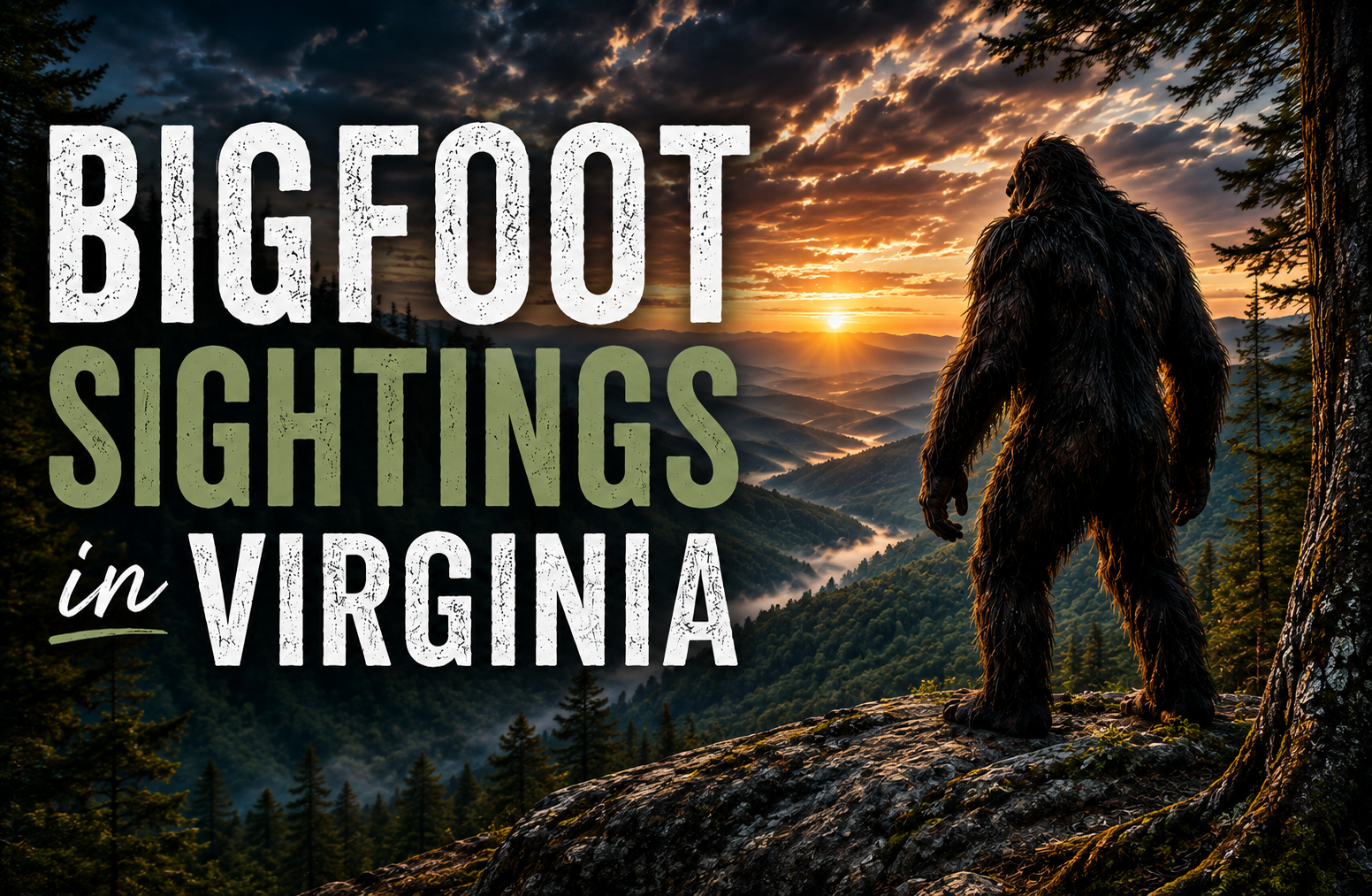
Virginia probably isn't the first place most people think of when they hear the word Bigfoot.
The Pacific Northwest gets most of the attention. Washington and Oregon have towering forests, remote mountains, and decades of Sasquatch lore.
But Virginia?
It turns out the Commonwealth has plenty of Bigfoot stories of its own.
From the Blue Ridge Mountains and Shenandoah Valley to the forests of Southwest Virginia and even the swamps near the coast, people have reported strange encounters with large, unidentified, human-like creatures for decades.
Some describe something crossing a road on two legs.
Others report enormous footprints.
There are stories of strange howls echoing through the mountains, trees being struck in the darkness, and large figures disappearing into the woods.
None of this proves Bigfoot exists, of course.
But there are enough Bigfoot sightings in Virginia to make you wonder why these stories continue appearing in so many different parts of the state.
And Virginia certainly has the landscape for a good mystery.
Are There Really Bigfoot Sightings in Virginia?
Yes—if by sightings we mean reported encounters.
The Bigfoot Field Researchers Organization, or BFRO, maintains one of the best-known databases of reported Bigfoot encounters in North America. Its database currently contains more than 90 reports from Virginia.
Those reports are spread across the Commonwealth rather than being confined to one small area.
And they aren't all recent.
Virginia's Bigfoot stories stretch back decades, with reports coming from hikers, hunters, campers, drivers, homeowners, and people simply spending time outdoors.
The descriptions vary, as you'd expect.
But certain elements appear repeatedly:
A large figure covered in dark or reddish-brown hair
Movement on two legs
Unusual screams, howls, or whooping sounds
Large footprints
Wood-knocking sounds
Strong or unusual odors
Something moving quickly into dense forest
A feeling of being watched from the woods
Could some of those encounters have been black bears?
Almost certainly.
Could others have been people, shadows, unfamiliar animal sounds, or simply our imaginations filling in the blanks?
Absolutely.
But every once in a while, there's a story that's a little harder to dismiss.
Bigfoot in Shenandoah National Park
For me, this is where the Virginia Bigfoot story gets particularly interesting.
Shenandoah National Park contains nearly 200,000 acres along the Blue Ridge Mountains.
People tend to think of Shenandoah as crowded overlooks along Skyline Drive.
Walk a few miles away from the road, however, and it becomes an entirely different place.
Dense forest.
Deep hollows.
Rocky ridges.
Streams.
Thick vegetation.
And plenty of places where something could disappear from view almost instantly.
There are reported Bigfoot encounters from the Shenandoah region, including an account submitted to the BFRO involving a couple traveling through the mountains in 1970.
According to their report, they saw a large, hairy figure cross the road in front of them before moving down the roadside and disappearing into the woods.
They believed it was moving on two legs and said they didn't think it was a bear.
Is that proof of a Virginia Sasquatch?
No.
It's a story.
But imagine driving through the Blue Ridge in 1970, long before everyone carried a camera in their pocket, and watching something large and hairy suddenly cross the road in front of your car.
You'd probably remember it too.
I've written separately about Bigfoot in Shenandoah National Park, because the combination of reported encounters and the landscape itself makes the park one of Virginia's most interesting places to explore the legend.
The Shenandoah Valley Has Its Own Bigfoot Stories
The stories aren't confined within the boundaries of the national park.
Bigfoot reports have surfaced throughout the greater Shenandoah Valley and Blue Ridge region.
In fact, the legend is established enough locally that Virginia State Parks has offered a program at Shenandoah River State Park dedicated to the subject.
The program, called The Search for Sasquatch, explores local Bigfoot history around a campfire before taking participants on a nighttime hike.
Think about where that park sits.
It's near Bentonville in Warren County, with the Shenandoah River running beside it and Massanutten Mountain rising nearby.
To the east are the Blue Ridge Mountains and Shenandoah National Park.
To the west are miles of mountainous national forest.
If you were designing fictional Bigfoot habitat for a movie, you could do a lot worse.
Bigfoot in the George Washington National Forest
Travel west of the Shenandoah Valley and the landscape becomes even more interesting.
The George Washington and Jefferson National Forests encompass enormous stretches of mountainous terrain through western Virginia.
This is where the Bigfoot question becomes fun to think about.
Virginia has a population of more than eight million people, so we don't usually think of it as wilderness.
But look at western Virginia on a satellite map.
There are huge stretches of forest running along the Appalachian Mountains.
Now imagine trying to locate one particular black bear somewhere in those mountains.
Good luck.
That doesn't mean an undiscovered giant primate is hiding there.
It simply illustrates how easy it is to underestimate the amount of wild country Virginia still has.
And there are Bigfoot stories from these forests as well.
Campers and outdoor enthusiasts have described unexplained nighttime activity, strange odors, vocalizations, and encounters they couldn't easily identify.
Again, none of those accounts constitute scientific evidence.
But they certainly make sitting around a campfire in the Virginia mountains a little more interesting.
Southwest Virginia's Woodbooger
Head farther southwest and Bigfoot gets another name.
The Woodbooger.
The Woodbooger is a Bigfoot-like creature associated particularly with the Appalachian folklore around Norton and Southwest Virginia.
Stories describe a large, hairy humanoid inhabiting the mountains and forests.
The legend became prominent enough that Finding Bigfoot traveled to the area, and Virginia's Appalachian folklore continues to celebrate the Woodbooger today.
PBS explored the legend in its Life in Virginia's Appalachia series, examining how stories of the creature became intertwined with local culture.
One particularly well-known story involved a father and son riding ATVs in 2009 when they reportedly saw a large creature cross their path.
The encounter became known as the Beast of Gum Hill.
Whether the Woodbooger is an actual creature, a variation of the larger Bigfoot legend, or simply a great piece of Appalachian folklore depends entirely on whom you ask.
But that's part of what makes the story interesting.
Bigfoot isn't merely a creature people claim to see.
Over time, it becomes part of the culture of a place.
Bigfoot Near Northern Virginia?
Here's another surprising part of Virginia's Bigfoot lore.
You don't necessarily have to travel deep into Appalachia.
There have also been reported encounters much closer to Northern Virginia.
One BFRO report describes an alleged encounter dating to 2005 at Marine Corps Base Quantico.
According to the account, Marines conducting nighttime maneuvers encountered an approximately eight-foot-tall figure in a wooded training area.
The report wasn't submitted until many years later, which obviously makes independent verification difficult.
But it's another example of how geographically widespread Virginia's Bigfoot reports are.
There have also been stories from the forests around Spotsylvania County and Lake Anna.
A 2010 Washington Post story profiled Virginia Bigfoot researchers investigating reports in that region.
Suddenly Bigfoot doesn't seem confined to some distant Appalachian hollow.
Some of the stories are surprisingly close to Washington, D.C.
Even the Great Dismal Swamp Has a Bigfoot Legend
Perhaps my favorite Virginia Bigfoot location isn't in the mountains at all.
It's the Great Dismal Swamp region of southeastern Virginia.
If you've never seen the area, the name alone sounds like somewhere a mysterious creature ought to live.
And sure enough, there are stories.
In 1981, The Washington Post reported on claims of a large, hairy creature around Northwest River Park near the swamp.
A park ranger jokingly called the creature “Skunkfoot.”
Reports described something extremely tall, hairy, and accompanied by a terrible smell.
Mountain Bigfoot gets all the attention.
Swamp Bigfoot might be considerably creepier.
Why Does Virginia Have So Many Bigfoot Stories?
There's an obvious answer.
Virginia has a lot of forest.
The Appalachian Mountains run along much of the western side of the state.
Shenandoah National Park protects a huge portion of the Blue Ridge.
National forests stretch across western Virginia.
There are wildlife management areas, state forests, river corridors, swamps, and remote private land.
Virginia also has a large black bear population.
And that last part matters.
Bears are probably one of the best conventional explanations for at least some Bigfoot sightings.
A large black bear standing upright—even briefly—can look remarkably human-like from a distance.
Add darkness, trees, adrenaline, and only a few seconds to understand what you're seeing, and it's easy to imagine how a bear becomes something much stranger in someone's memory.
But there's another reason these stories thrive here.
The landscape feels right.
The Appalachian Mountains Were Made for Stories Like This
Spend enough time in the mountains and you'll understand what I mean.
During the day, a Virginia forest can feel peaceful and inviting.
After sunset?
Everything changes.
Visibility drops to almost nothing.
A deer walking through leaves sounds enormous.
A fox can make a scream that sounds like it came from another world.
Owls make noises people don't expect.
Coyotes begin calling across the ridges.
Branches snap.
Something moves outside the beam of your flashlight.
Your brain immediately wants to know:
What was that?
For generations, Appalachian communities have created stories around the mysteries of the mountains.
Bigfoot—or the Woodbooger—is simply one of the most famous.
Could Bigfoot Actually Live in Virginia?
That's the million-dollar question.
From a purely habitat standpoint, Virginia certainly has forests, water, wildlife, and remote terrain.
The much harder problem is biology.
For Bigfoot to exist as an animal species, there almost certainly couldn't be just one.
There would need to be a breeding population.
That means multiple animals living, feeding, reproducing, dying, and moving through the landscape.
And that's where the scientific case becomes difficult.
Where are the bodies?
Where are the bones?
Where is the DNA?
Why hasn't a trail camera captured indisputable evidence?
Those are legitimate questions.
Despite decades of reported sightings, there is currently no scientifically accepted evidence establishing the existence of Bigfoot.
That shouldn't be glossed over.
But neither does that mean every witness who reports something unusual in the Virginia woods is lying.
Sometimes people simply see something they cannot identify.
And occasionally, those stories become legends.
Where Are the Best Places to Look for Bigfoot in Virginia?
If you're determined to go Squatching in Virginia, I'd start with the places where wilderness and folklore overlap.
The Shenandoah Valley and Blue Ridge Mountains would be high on my list.
So would the George Washington and Jefferson National Forests.
Southwest Virginia gives you the added bonus of Woodbooger country.
And if you're feeling particularly adventurous, there's always the Great Dismal Swamp.
Just remember that the animals we know live in these places deserve considerably more respect than the one we're not sure about.
Virginia's forests contain black bears, snakes, coyotes, and other wildlife.
Know where you're going, respect park and forest regulations, don't approach wildlife, and don't wander into unfamiliar terrain at night just because you heard something strange.
So, Is Bigfoot in Virginia?
I don't know.
And that's exactly why I enjoy the subject.
There are reported Bigfoot sightings in Virginia stretching across decades and covering nearly every type of landscape the Commonwealth has to offer.
There are stories from Shenandoah.
Stories from Southwest Virginia.
Stories from Northern Virginia.
Even stories from the swamps near the coast.
Most probably have perfectly ordinary explanations.
Maybe all of them do.
But when you're standing alone on a trail in the Blue Ridge and hear something large moving through the woods where you can't quite see it, those explanations don't always come to mind first.
For just a second, you listen.
You look toward the trees.
And you wonder.
What if?
More from Scott Turnmeyer
I write about photography, business, mindset, bowling, and the bigger questions that don’t always have easy answers. You can explore more articles, photography, and projects here:
Blog Home
About Scott Turnmeyer
Fine Art Photography
Photography Workshops & Experiences
Digital Consulting