
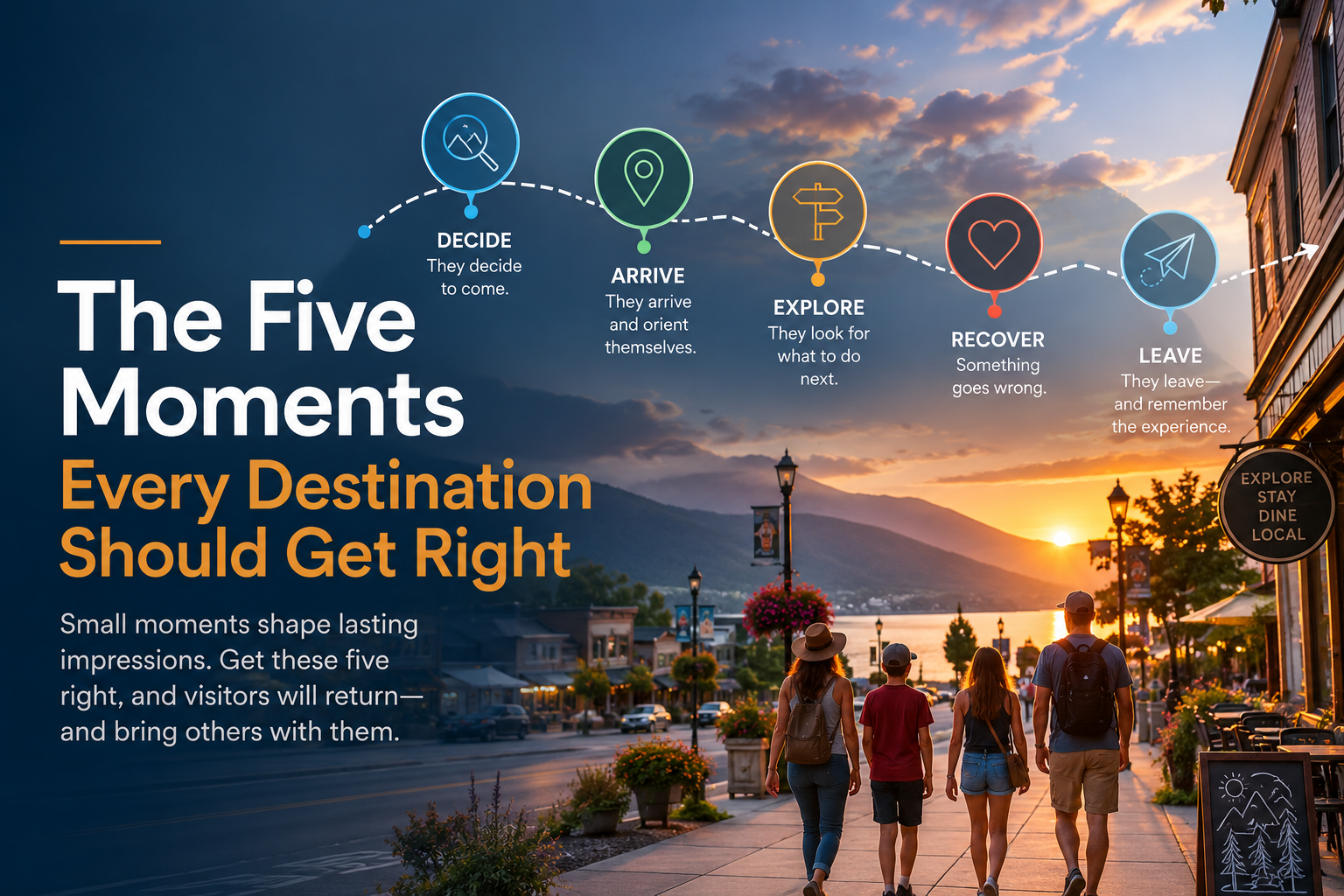
The Five Moments Every Destination Should Get Right
Destinations spend a lot of time trying to convince people to visit.
We build websites. We create videos. We run advertising campaigns. We post beautiful photographs. We talk about our restaurants, attractions, mountains, history, festivals, shops, and everything else that makes our community worth experiencing.
But getting someone to visit is only the beginning.
The real test starts when they arrive.
A visitor's perception of a destination isn't usually shaped by one attraction, one meal, or one photograph. It is built through a series of small moments. Some last only a few seconds, but collectively they determine whether someone leaves thinking:
"That was a great place. We need to come back."
Or:
"It was fine."
That difference matters.
Because successful tourism isn't simply about attracting more visitors. It's about creating visitors who stay longer, spend more, return again, and tell other people they should visit too.
And there are five moments I believe every destination should work especially hard to get right.
1. The Moment They Decide Whether to Come
The visitor experience begins long before someone crosses your town or county line.
It begins on a phone.
Someone sees a photograph on Instagram. They search Google for things to do. They find a restaurant on Facebook. They watch a TikTok video. They visit the destination's website. Maybe they ask an AI assistant to build them a weekend itinerary.
Within minutes, they're forming an opinion.
Does this place look interesting?
Is there enough to do?
Where should we stay?
Can we bring the kids?
What does downtown look like?
Are there good restaurants?
What can we do if it rains?
And perhaps the most important question:
Is this worth the trip?
Destinations sometimes approach marketing as if the goal is simply to make people aware that they exist.
Awareness isn't enough.
Our digital presence has to help someone imagine themselves here.
A beautiful mountain photograph might get someone's attention. But a potential visitor also needs to see the brewery where they can stop afterward, the downtown where they can spend the afternoon, the restaurant where they can have dinner, and the place where they can stay overnight.
We aren't just selling attractions.
We're selling the possibility of an experience.
The easier we make it for someone to picture that experience, the easier we make the decision to visit.
2. The Moment They Arrive
Think about the first ten minutes after someone enters a destination.
What do they see?
What do they feel?
More importantly, do they immediately feel like they've arrived somewhere?
This is one of the most overlooked parts of tourism development.
Communities spend significant money telling people to visit, but sometimes very little attention is paid to what happens once those visitors actually get here.
Is the entrance into the community attractive?
Is signage clear?
Can visitors easily figure out where downtown is?
Can they find parking?
Do they know where the attractions are?
Is the area clean and welcoming?
A visitor shouldn't have to work to understand a destination.
The best destinations provide subtle signals that say:
You're here. Here's where to go. Here's what to explore.
Wayfinding signs, attractive gateways, landscaping, clean public spaces, accessible parking information, maps, and thoughtful streetscapes aren't just beautification projects.
They're tourism infrastructure.
They reduce friction.
And reducing friction makes exploring easier.
3. The Moment They Ask, "What Do We Do Now?"
This may be the most important moment of all.
The visitor has arrived. Maybe they completed the activity that originally brought them here.
Now what?
This is where destinations either capture additional economic activity or lose it.
Imagine a family comes for a morning hike.
They finish around noon.
Do they immediately drive home?
Or do they know there's a downtown fifteen minutes away with restaurants, shops, museums, breweries, galleries, or another attraction worth visiting?
The difference can represent hundreds of dollars in local economic activity from a single family.
This is why tourism can't operate as a collection of isolated businesses and attractions.
A hiking trail benefits from a nearby restaurant.
A restaurant benefits from a nearby shop.
A shop benefits from a nearby festival.
A hotel benefits from all of them.
The visitor doesn't see separate businesses, organizations, jurisdictions, or marketing budgets.
They see one destination.
Our job is to connect the pieces.
That means cross-promotion between businesses. Suggested itineraries. QR codes. Maps. "While you're here" recommendations. Front-line employees who know what else is happening nearby.
Every business that interacts with a visitor has the opportunity to become a miniature visitor center.
A simple question like, "What are you doing after this?" can change the entire economics of a visit.
4. The Moment Something Goes Wrong
No destination gets everything right.
A restaurant will have a long wait.
A trail will close.
It will rain.
An event will be canceled.
Someone will get lost.
A hotel reservation will get mixed up.
A visitor may simply have a bad experience.
The mistake itself doesn't always determine how someone feels about a destination.
What happens next often does.
Visitors remember how people respond.
Was someone helpful?
Did they offer an alternative?
Did they act like solving the problem mattered?
One of the most powerful tourism assets any community has isn't a mountain, river, museum, festival, or historic building.
It's hospitality.
And hospitality doesn't require a tourism degree.
It happens when a store employee recommends another local business.
It happens when someone gives directions instead of saying, "I don't know."
It happens when a restaurant employee suggests another nearby restaurant when theirs has a two-hour wait.
It happens when residents understand that visitors aren't interruptions. They're customers of the community.
We can spend millions building tourism brands.
One unpleasant interaction can damage that brand in five minutes.
The opposite is also true.
One unexpectedly helpful person can become part of the story someone tells about their trip.
5. The Moment They Leave
This may be the biggest missed opportunity in tourism.
The visitor gets in the car.
They head home.
And the destination stops talking to them.
Why?
Someone who has already visited is one of the most valuable audiences a destination has.
They already know where you are.
They already know how long the drive takes.
They've already experienced the community.
You've overcome the hardest obstacle: convincing them to come the first time.
Now give them a reason to return.
Maybe they visited in October.
Show them what the destination looks like at Christmas.
Maybe they came for hiking.
Tell them about kayaking.
Maybe they visited for a festival.
Introduce them to a winery, museum, historic site, concert series, or downtown event.
The goal shouldn't be one visit.
The goal should be creating a relationship with the visitor.
Because repeat visitors behave differently.
They become more comfortable exploring.
They discover businesses they missed the first time.
They bring friends and family.
They recommend the destination.
Eventually, some may even begin thinking of the community as their place.
That's an incredibly powerful position for a destination to occupy.
Tourism Is a Chain of Experiences
There is a tendency in tourism to focus heavily on the top of the funnel.
How many people saw the advertisement?
How many visited the website?
How many people attended the event?
Those numbers matter.
But they don't tell the entire story.
A destination can have excellent marketing and still deliver a mediocre visitor experience.
And when that happens, we're constantly paying to replace visitors instead of building loyalty among the people we've already attracted.
The better question is:
What happens after the marketing works?
That's where destination development becomes just as important as destination marketing.
We need to examine the entire visitor journey—from discovery to arrival, exploration to problem solving, and eventually departure.
Then we need to remove friction wherever we find it.
Make things easier to discover.
Make the destination easier to navigate.
Connect attractions with businesses.
Help visitors find the next thing to do.
Create a culture of hospitality.
And stay connected after they leave.
None of those ideas are particularly complicated.
But when hundreds of businesses, residents, organizations, and local governments begin thinking about the visitor experience together, something powerful happens.
A collection of attractions becomes a destination.
And a place people visited once becomes a place they can't wait to visit again.
More from Scott Turnmeyer
I write about photography, business, mindset, bowling, and the bigger questions that don’t always have easy answers. You can explore more articles, photography, and projects here:
Blog Home
About Scott Turnmeyer
Fine Art Photography
Photography Workshops & Experiences
Digital Consulting