
Could the Body Be a Container for Consciousness?
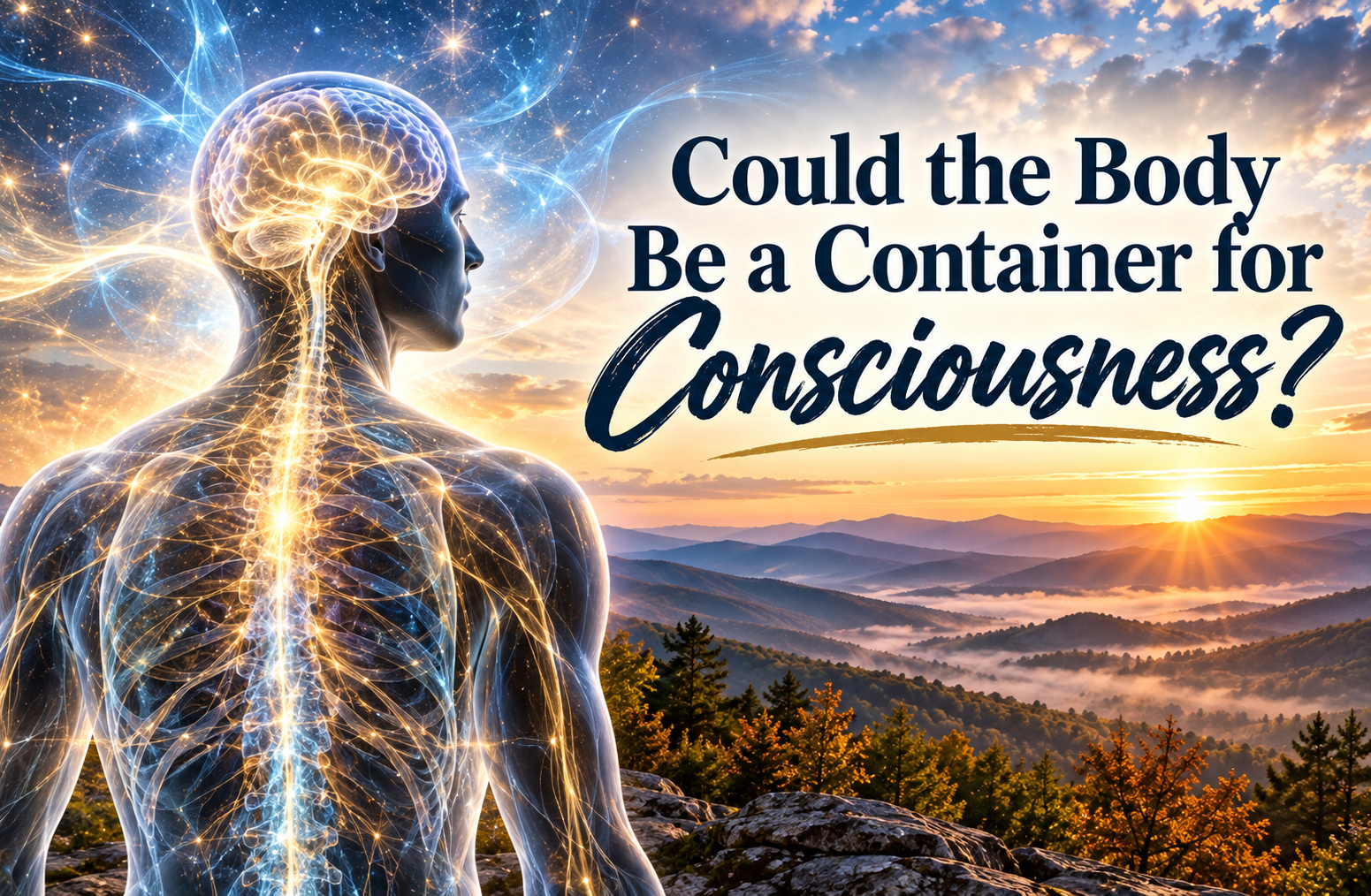
For most of my life, I assumed consciousness worked in a fairly straightforward way.
The brain creates it.
Billions of neurons interact, electrical and chemical signals move through the brain, and somehow all of that activity produces the experience we call me.
My thoughts.
My memories.
My personality.
My awareness that I exist.
When the brain stops functioning, consciousness stops too.
That's certainly the conventional explanation, and there are very good reasons for it. Change the brain and you can change memory, personality, perception and behavior. Damage particular areas of the brain and specific abilities can disappear. Anesthesia can seemingly switch consciousness off and back on again.
The connection between the brain and our conscious experience is undeniable.
But I've increasingly found myself wondering whether we've made an assumption about what that connection actually means.
What if the brain doesn't create consciousness?
What if it receives it, filters it, limits it or translates it?
And if that's possible, then perhaps the body isn't the source of consciousness at all.
Perhaps the body is the container through which consciousness experiences this world.
I don't know that this is true.
But I think it's an interesting question.
And if we're willing to explore it without first demanding that the answer fit what we already believe, it leads to some fascinating possibilities.
The Brain as Producer
The dominant scientific model is essentially a production model.
Conscious experience emerges from activity in the brain.
We have enormous evidence connecting mental states to physical brain states.
Alter the brain with alcohol and consciousness changes.
Give someone anesthesia and conscious awareness can disappear.
Damage the visual cortex and vision can be affected.
Diseases of the brain can profoundly alter memory, cognition and personality.
All of that strongly demonstrates that the brain is intimately involved in consciousness.
But here's the question I've been thinking about:
Does showing that the brain affects consciousness necessarily prove that the brain produces consciousness?
Consider a television.
Damage the screen and the picture becomes distorted.
Damage the speakers and the sound disappears.
Destroy part of its circuitry and entire portions of the experience may be lost.
Eventually, damage it enough and nothing appears on the screen at all.
If we knew nothing about television signals, we might reasonably conclude that the television itself was creating everything we saw.
But it isn't.
The television is receiving and translating information.
Destroying the television destroys our ability to experience the program through that television.
It doesn't necessarily destroy the source.
Now, to be clear, that analogy isn't evidence that consciousness works this way.
A brain is obviously vastly more complicated than a television.
But the analogy illustrates an important distinction:
A system being necessary for our experience of something does not automatically establish that the system is the ultimate source of it.
What If the Brain Is More Like a Receiver?
This isn't an entirely new idea.
Philosophers and researchers have proposed variations of what are sometimes called transmission, filter or receiver theories of consciousness.
Instead of generating consciousness, the brain could hypothetically constrain or translate a broader consciousness into the limited experience available to a human being.
That possibility fascinates me.
Because if the brain is a receiver—or perhaps more accurately, an interface—then the body begins to look very different.
Your eyes determine which wavelengths of light you can see.
Your ears determine which frequencies you can hear.
Your nervous system determines what sensations you experience.
Your brain determines how information is processed and interpreted.
The physical organism establishes the boundaries of the experience.
In that sense, the body already functions as a kind of biological interface between whatever you are and the physical environment around you.
The unanswered question is whether the consciousness experiencing that information is entirely contained within that machinery.
Think About How Limited Our Experience Already Is
Humans tend to assume we're experiencing reality as it actually exists.
We're not.
We're experiencing the portion of reality our bodies evolved to detect.
There are wavelengths of electromagnetic radiation we cannot see.
There are frequencies of sound we cannot hear.
Other animals detect magnetic fields, ultraviolet light, electrical signals and chemical information that we experience poorly—or not at all.
Our world feels complete because we've never experienced anything else.
But our experience is actually incredibly restricted.
That raises an interesting possibility.
What if our brains don't simply allow consciousness?
What if they also limit it?
Imagine consciousness as something much larger being squeezed through the sensory and cognitive capabilities of a human body.
The resulting experience would feel complete from inside the container because it is all we've ever known.
But it wouldn't necessarily represent everything consciousness itself could experience.
The Container May Shape the Experience
This idea becomes even more interesting when we think about animals.
I've written before about whether animals might possess the same kind of consciousness we do while being limited by very different physical containers.
A dog's world is dominated by smell in a way ours simply isn't.
An eagle experiences vision at a level we cannot.
A bat navigates using echolocation.
A dolphin's sensory world is different again.
If consciousness exists independently from the physical organism, perhaps the differences between us aren't necessarily differences in the underlying consciousness.
Maybe we're looking at different interfaces.
Different hardware.
Different containers.
Put consciousness into a human brain and you get one type of experience.
Put it into a dog and you get another.
Put it into an eagle and the world changes again.
That's speculation, obviously.
But it offers an intriguing way of thinking about why consciousness might manifest so differently across living creatures.
Why Would Consciousness Need a Container?
This leads to the bigger question.
Why?
Why would consciousness enter a limited physical body at all?
I keep coming back to the possibility that limitations may be the point.
If consciousness existed without physical restrictions—without hunger, pain, fear, uncertainty, distance, time or mortality—could it have the same experiences available here?
Think about courage.
Courage requires fear.
Patience requires waiting.
Forgiveness requires being hurt.
Generosity means something because resources can be limited.
Love becomes consequential because we can lose the people and animals we love.
Knowledge has value because we begin without knowing.
Maybe physical existence isn't simply something consciousness happens to experience.
Maybe the constraints of physical existence create experiences consciousness couldn't have otherwise.
The container isn't necessarily a prison.
It could be part of the curriculum.
And What About Memory?
This also intersects with another question I've spent a lot of time thinking about.
If consciousness existed before entering the body, why don't we remember it?
Maybe we're not supposed to.
Imagine playing a game while remembering every previous attempt, knowing every outcome and already understanding every lesson.
The experience would fundamentally change.
Uncertainty matters.
Choice matters because we don't know exactly what comes next.
Discovery matters because we don't already know the answer.
If physical life is somehow experiential, perhaps access to whatever came before would defeat part of its purpose.
Under that hypothesis, the brain might do more than connect consciousness to the physical world.
It might also restrict what consciousness can access while it's here.
Again, that's not something we currently know.
But it's an interesting possibility.
Death Looks Very Different Under This Model
This is where the container hypothesis becomes especially consequential.
If the brain produces consciousness, then when the brain permanently stops functioning, the individual conscious experience presumably ends.
But if the brain instead receives, filters or interfaces with consciousness, death could mean something entirely different.
The container stops functioning.
The connection ends.
But the consciousness itself may not.
The broken television analogy becomes relevant again.
The screen goes dark.
That tells us something definitive about the television.
It doesn't necessarily tell us what happened to the signal.
And this is where questions surrounding near-death experiences, reports of unusual end-of-life experiences, claims of memories from young children, and other anomalous consciousness research become interesting to me.
None of those phenomena automatically prove survival after death.
They shouldn't be treated as though they do.
But if even some of them eventually resist conventional explanations, they could become clues that our current model of consciousness is incomplete.
There Is a Huge Problem With This Idea
Of course, there's an enormous problem with everything I've just described.
We don't know where this external consciousness would be.
We don't know what it would consist of.
We don't know how it would interact with neurons.
We don't know how information would move between consciousness and the brain.
We don't know how to reliably detect it independently of the body.
And we don't currently have scientific evidence establishing that consciousness exists separately from a functioning brain.
Those aren't small problems.
They're the central problems.
Saying "the brain might be a receiver" doesn't solve the mystery of consciousness.
In some ways, it simply moves the mystery somewhere else.
Any serious version of this hypothesis eventually has to explain mechanism and produce testable predictions.
Otherwise it remains philosophy rather than established science.
And that's where I think intellectual honesty matters.
I can find an idea fascinating without pretending I've proven it.
But the Conventional Explanation Has a Mystery Too
At the same time, saying "the brain creates consciousness" doesn't make the fundamental mystery disappear either.
We can increasingly map what happens in the brain when people see something, remember something, make a decision or experience an emotion.
But there's still a profound philosophical and scientific question underneath all of it:
Why does any of that processing produce subjective experience?
Why isn't it all happening in the dark?
Why is there something it feels like to be you?
How does physical activity become the experience of seeing blue?
Or feeling grief?
Or loving someone?
Or remembering your childhood?
Or simply realizing:
I exist.
We know an extraordinary amount about the brain.
But consciousness remains one of the deepest unanswered questions we have.
Maybe We Should Leave the Question Open
I don't know whether my body is producing the consciousness writing these words or whether it's providing the interface through which that consciousness is temporarily operating.
Neither does anyone else with certainty.
And I'm becoming increasingly comfortable with that answer:
I don't know.
Because "I don't know" isn't the end of curiosity.
It's the beginning of it.
Maybe consciousness is entirely generated by the brain and someday neuroscience will explain exactly how subjective experience emerges from physical matter.
Maybe consciousness is somehow fundamental to reality itself.
Maybe the brain is a filter or receiver.
Maybe the truth is something none of our current theories have imagined yet.
But I think we should be willing to ask the question.
Because if the body really is a container for consciousness, then something extraordinary follows.
You aren't your body.
Your body is the mechanism allowing you to experience this particular version of reality.
And when the container eventually stops working, perhaps the most important question isn't what happens to the body.
It's what happens to whatever was experiencing the world through it.
More from Scott Turnmeyer
I write about photography, business, mindset, bowling, and the bigger questions that don’t always have easy answers. You can explore more articles, photography, and projects here:
Blog Home
About Scott Turnmeyer
Fine Art Photography
Photography Workshops & Experiences
Digital Consulting