
What a Time to Be Alive: Humanity Is Entering an Extraordinary Decade
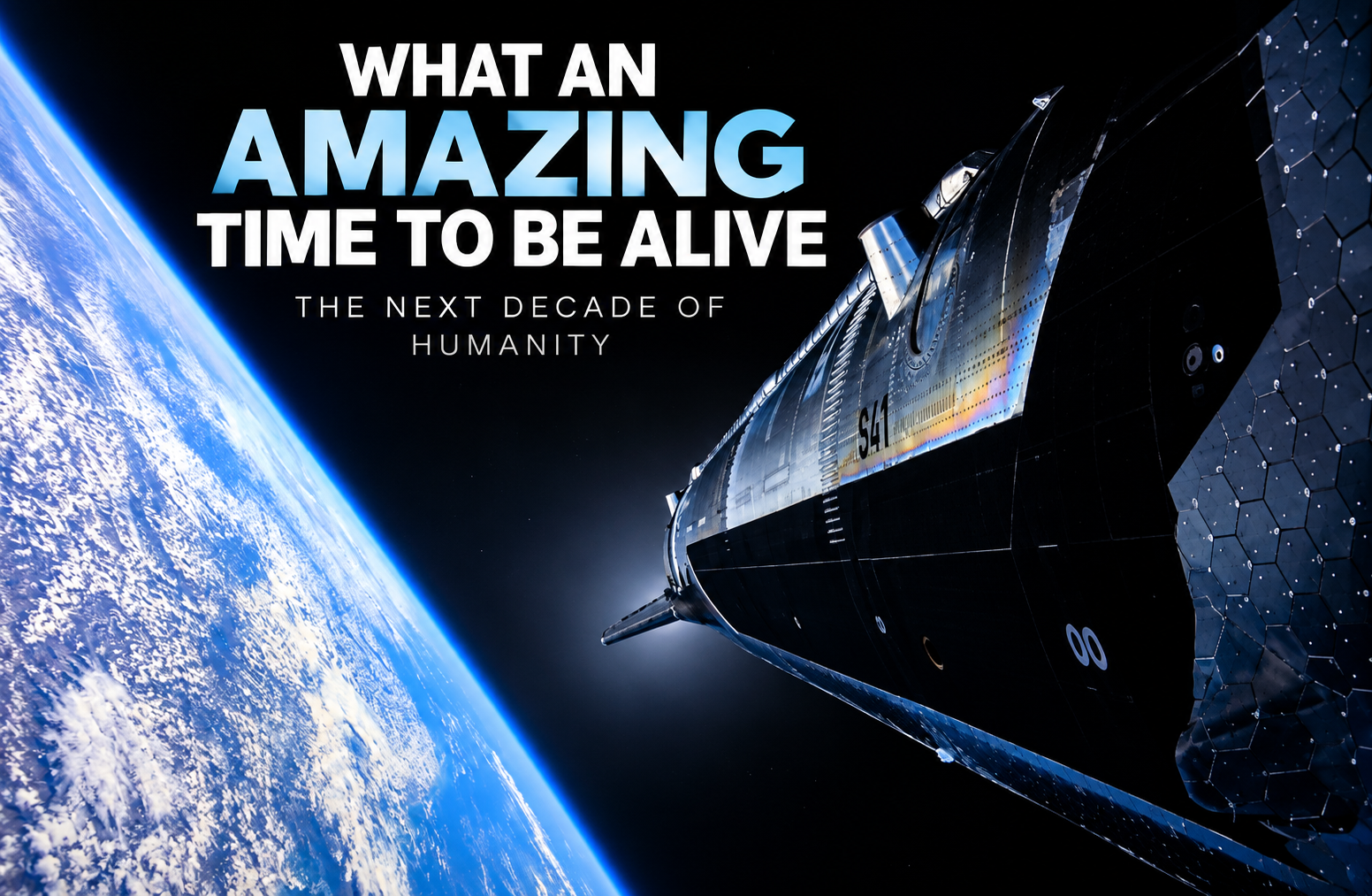
This morning, I sat watching something that would have sounded like science fiction for most of my life.
A 400-foot-tall spacecraft had just left Earth.
Not simply gone into space. We've been doing that for decades.
This time, SpaceX's Starship was attempting something it had never done before: entering Earth orbit and beginning the transition from an experimental spacecraft into something capable of actually carrying useful payloads into space.
And as I watched the Earth drift beneath it, Starship was preparing to deploy 26 next-generation Starlink V3 satellites.
I found myself thinking:
What an absolutely amazing time to be alive.
I don't think we appreciate it enough.
We Spend So Much Time Looking at What's Wrong
Turn on the news.
Open social media.
Look at the headlines.
War. Politics. Debt. Crime. Division. Inflation. Anger.
If that's the primary lens through which we view the world, it would be incredibly easy to conclude that humanity is moving backward.
But zoom out a little.
Because something else is happening at exactly the same time.
Human civilization may be entering one of the greatest periods of technological advancement in our history.
Artificial intelligence is developing at a remarkable pace.
Robots are moving from factories into homes and everyday businesses.
Medicine is becoming increasingly personalized.
Gene-editing technologies are giving researchers tools previous generations couldn't have imagined.
We are beginning to build machines capable of operating autonomously in the physical world.
And this morning, I watched a gigantic spacecraft orbit the planet carrying a new generation of satellites.
The future isn't something our grandchildren are going to experience.
It's arriving right now.
Starship Changes More Than Space Travel
The importance of Starship isn't simply that it's a really big rocket.
We've built big rockets before. SpaceX said in today’s broadcast that one Starship could carry the load of 20 Falcon 9 rockets that they have been using for years now to deploy payloads. 20x in one launch.
The potentially transformative part is what SpaceX is trying to do with it: create a massive transportation system that can eventually be reused again and again.
That changes the economics of space.
For decades, getting something into orbit has been incredibly expensive and difficult. Every kilogram mattered. Every spacecraft had to be designed around the limitations of the rocket carrying it.
Starship is attempting to change that equation.
SpaceX says future Starship missions could carry as many as 60 of its enormous Starlink V3 satellites per launch. Each V3 satellite is designed to provide around one terabit per second of downlink capacity.
Think about what that represents.
We're moving toward a world where high-speed communications infrastructure can be launched into orbit by the dozens aboard a single spacecraft.
And that's only one application.
Larger telescopes.
Larger scientific instruments.
Space stations.
Lunar equipment.
Manufacturing.
Exploration vehicles.
Infrastructure that hasn't even been invented yet.
Once transportation becomes cheaper and more abundant, people inevitably invent things to do with that transportation.
We saw it with railroads.
We saw it with automobiles.
We saw it with airplanes.
And we may be watching the beginning of the same phenomenon with space.
Then There's Artificial Intelligence
At the same time we're dramatically improving our ability to reach space, something equally significant is happening here on Earth.
Artificial intelligence is accelerating our ability to work with information.
I've experienced this personally.
Things that would have required specialized knowledge, multiple people or days of work just a few years ago can increasingly be accomplished by one person working with AI.
And we're still near the beginning.
Now imagine where that technology goes over the next five years.
Then combine it with robotics.
AI that can reason about a problem is impressive.
AI connected to machines capable of interacting with the physical world is something entirely different.
Suddenly we're talking about robots helping build homes, manufacture products, care for people, explore dangerous environments and perform work humans simply don't want or need to do anymore.
None of this means every prediction about AI or robotics will come true.
They won't.
Technology rarely develops exactly the way people expect.
But the direction is difficult to ignore.
Medicine May Become Unrecognizable
This may ultimately be the technological revolution that matters most.
AI is increasingly being used to analyze enormous amounts of biological information. Gene-editing technologies continue advancing. Researchers are learning more about cancer, aging, neurological disease and the mechanisms underlying thousands of conditions.
Imagine what happens when increasingly capable AI systems can assist scientists in evaluating millions of possible compounds, proteins and genetic interactions.
Problems that once required years of human trial and error may increasingly become computational problems as well.
Does that mean we're about to eliminate disease?
Of course not.
But I wouldn't bet against the possibility that a child born today will experience healthcare at age 50 that would look almost miraculous to us.
And We're Going Back Out There
This may be the part that fascinates me the most.
For most of my lifetime, humans haven't traveled farther than low Earth orbit.
The Moon landings happened before I was born.
For decades afterward, human space exploration seemed almost frozen. I dreamed one day of being the first person to step on Mars. That dream is no longer possible for me personally but I know see the possibility of it happening within my lifetime.
That is changing.
NASA's Artemis program is designed around returning humans to the Moon and establishing a longer-term presence there, with Starship itself playing a role as a lunar landing system.
But the Moon isn't necessarily the destination.
It's another beginning.
Mars remains extraordinarily difficult. There are enormous engineering, biological and logistical problems that have yet to be solved.
But we're finally building machines designed around the idea that humans might actually become a civilization that operates beyond Earth.
Whether that happens in ten years, twenty years or fifty years isn't really the point.
We've started building the tools.
Think About What Has Already Happened
There's another reason today's Starship flight struck me.
Exactly 18 years ago, on September 28, 2008, SpaceX's Falcon 1 became the company's first rocket to reach orbit.
Today, September 28, 2026, Starship is attempting its first orbital mission.
Eighteen years.
That's it.
Think about the technological difference between those two vehicles.
Then ask yourself a fascinating question:
What does another eighteen years look like?
Or forget eighteen.
What does five look like?
What does ten look like?
That's where my mind starts wandering.
The Convergence Is What Makes This Different
Any one of these technologies would be fascinating on its own.
But they're not developing independently.
That's the part I think we underestimate.
AI helps engineers design better machines.
Robotics helps manufacture them.
Better launch systems make space infrastructure cheaper.
Satellite networks connect more of the planet.
More computing power accelerates scientific discovery.
Advances in energy make computing and transportation more practical.
Advances in medicine extend and improve human lives.
Each technology begins feeding the others.
And technological progress can become less like a straight line and more like a snowball rolling downhill.
That's why I suspect the world of 2036 may feel substantially more different from 2026 than the world of 2026 feels from 2016.
Maybe I'm wrong.
Predictions about the future usually are.
But look at what's already happening.
We Still Have Problems to Solve
Technology won't magically fix humanity.
We'll still argue.
We'll still make terrible decisions.
We'll still have wars, inequality, greed, suffering and political disagreements.
New technologies will create entirely new problems we haven't anticipated.
AI brings legitimate concerns.
Space commercialization raises legitimate questions.
Automation will disrupt careers and industries.
Every technological revolution creates winners, losers and enormous periods of adjustment.
We shouldn't ignore those realities.
But we shouldn't allow them to blind us to progress either.
Two things can be true simultaneously.
Humanity can have enormous problems while also accomplishing extraordinary things.
And we are accomplishing extraordinary things.
Imagine Explaining Today to Someone From 1926
I sometimes like doing this thought experiment.
Take someone living exactly 100 years ago and bring them into your house today.
Show them your smartphone.
Explain that it contains access to most of humanity's accumulated knowledge.
Tell them you can instantly video-chat with someone on the other side of the planet.
Show them an AI system and have a conversation with it.
Show them a modern electric vehicle.
Explain GPS.
Show them robotic surgery.
Then turn on the television and show them what I watched this morning:
A live, high-definition video transmitted from a spacecraft orbiting Earth while carrying satellites capable of providing high-speed internet from space.
Their world and ours would almost seem like different civilizations.
Now consider this:
Someone living in 2126 may look at us exactly the same way.
Maybe We Should Look Up More Often
There is plenty to worry about.
Believe me, I understand that.
But mornings like this remind me that occasionally we need to stop staring at everything that's broken and look at what we're building.
There are thousands upon thousands of engineers, scientists, programmers, machinists, researchers, doctors, entrepreneurs and dreamers working on problems that previous generations considered impossible.
Some will fail.
Some ideas will disappear.
Some technologies we're excited about today will probably look ridiculous twenty years from now.
But some will change civilization.
And somewhere right now, someone may be working on something none of us have even heard of yet that will eventually become part of everyday life.
That's exciting.
What a Time to Be Alive
This morning, Starship passed over a blue Earth while preparing to deploy a new generation of satellites.
It was one mission.
One spacecraft.
One company.
But to me, the image represented something much bigger.
It represented movement.
For all of humanity's faults—and there are plenty—we're still exploring.
We're still inventing.
We're still asking questions.
We're still trying things that might fail.
We're still looking beyond the horizon and wondering what's on the other side.
And when I think about artificial intelligence, robotics, medicine, energy, communications and space exploration all advancing simultaneously, I can't help but wonder what we're going to see during the next five to ten years.
Maybe permanent infrastructure on the Moon.
Maybe revolutionary medical treatments.
Maybe robots working alongside us every day.
Maybe AI helping scientists solve problems we've struggled with for generations.
Maybe humans preparing for Mars.
And probably things none of us are imaginative enough to predict today.
For all the reasons we're given to be pessimistic about humanity, I think there are some pretty compelling reasons to be optimistic too.
Sometimes you just have to look up.
What an amazing time to be alive.
More from Scott Turnmeyer
I write about photography, business, mindset, bowling, and the bigger questions that don’t always have easy answers. You can explore more articles, photography, and projects here:
Blog Home
About Scott Turnmeyer
Fine Art Photography
Photography Workshops & Experiences
Digital Consulting