
AI Will Change How People Travel
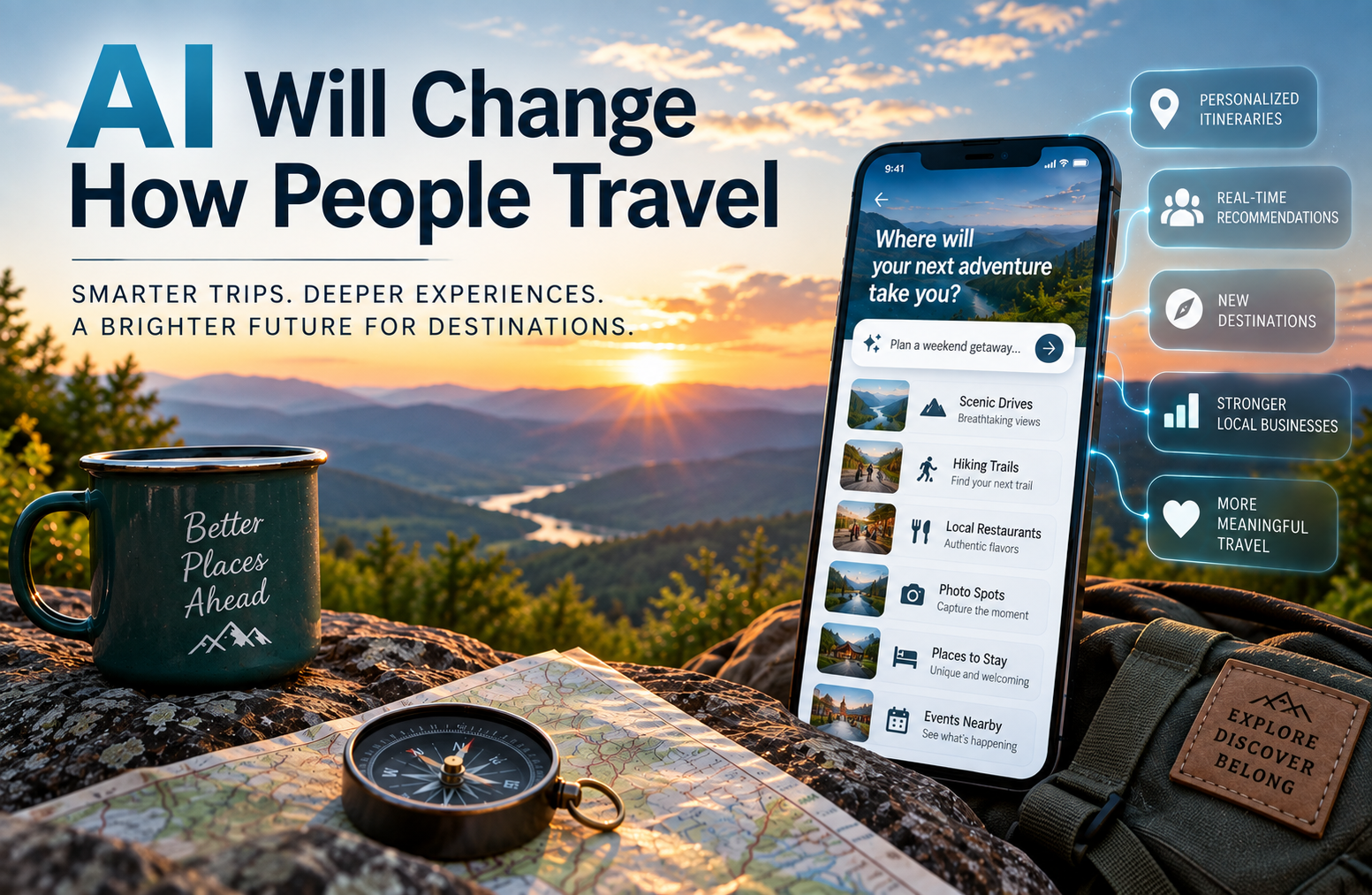
For most of the internet era, planning a trip has followed roughly the same process.
You decide where you want to go.
Then you start searching.
You Google things like best restaurants in Charleston, things to do in Shenandoah National Park, best family activities in Orlando, or three-day itinerary for Savannah.
You open a dozen tabs. You read travel blogs. You visit the destination's tourism website. You look at Google Maps. You check reviews. You save restaurants. You compare hotels.
Eventually, you assemble all of that information into something resembling a trip.
Artificial intelligence is about to change that process dramatically.
And I don't think the biggest change will simply be that AI makes travel planning faster.
AI is going to change how people discover destinations in the first place.
That has enormous implications for travelers—and perhaps even bigger implications for the people responsible for marketing and developing destinations.
From Searching to Asking
For more than two decades, travel marketing has largely revolved around search.
A traveler types something into a search engine.
The search engine provides a list of websites.
The traveler visits those websites and tries to find the answer.
AI changes that relationship.
Instead of searching:
“Things to do in the Shenandoah Valley”
a traveler can simply ask:
“My wife and I want a relaxing three-day getaway within two hours of Washington, D.C. We like scenic drives, local restaurants, small downtowns, photography and easy hikes. We don't want anything overly crowded. Where should we go?”
That's a completely different question.
More importantly, it's a completely different way of discovering a destination.
The traveler may not have even known to search for Front Royal, Luray, Winchester or another Shenandoah Valley community.
AI can introduce those places as solutions to what the traveler actually wants.
That means destinations will increasingly compete to be the answer—not just the search result.
AI Will Build Trips Around People, Not Attractions
Traditional tourism websites usually start with the destination.
Here are our attractions.
Here are our restaurants.
Here are our hotels.
Here are our events.
Here are our hiking trails.
The visitor is expected to figure out which combination of those things makes sense for them.
AI can reverse that process.
Imagine telling an AI travel assistant:
"We're traveling with two kids, ages 8 and 12. We like outdoor activities but don't want difficult hikes. One of us loves history. We want local restaurants instead of chains. We're staying Friday through Sunday, and it looks like rain Saturday afternoon."
Now the itinerary can be built around you.
The AI can potentially consider travel times, operating hours, weather, interests, ages, budget, accessibility, restaurant preferences and hundreds of other variables.
If rain moves in Saturday afternoon, the itinerary can change.
If the restaurant you planned to visit is closed, another can be suggested.
If you decide you're tired after hiking all morning, the afternoon can become something easier.
The itinerary becomes dynamic.
That's very different from downloading a PDF titled “Top 10 Things to Do.”
The Destination Website Isn't Going Away
I don't think destination websites disappear.
But I do think their role changes.
Historically, tourism organizations have spent enormous effort trying to get visitors onto their websites.
Pageviews mattered.
Google rankings mattered.
Getting someone to click Visit Our Destination mattered.
Those things will still have value.
But increasingly, a traveler may get the information they need without ever visiting the destination website first.
They may ask an AI assistant where to go, where to stay, what to eat and what to do.
That creates an interesting question for destination marketing organizations:
What happens when the traveler doesn't start with you?
The answer, in my opinion, isn't to fight AI.
It's to make sure AI has good information about your destination.
Your Information Becomes Infrastructure
This is where I think destination organizations need to start thinking differently.
A beautiful tourism website is still important.
But the information behind that website may become even more important.
Is your information current?
Are business hours accurate?
Are events clearly described?
Are addresses consistent?
Are trails identified by difficulty?
Are attractions described according to the experiences they offer?
Can someone determine whether something is appropriate for children?
Is accessibility information available?
Are parking instructions clear?
Can visitors tell how long an experience typically takes?
Is your information scattered across dozens of outdated webpages and PDFs?
AI travel planning is only as useful as the information available to it.
In an AI-driven travel world, structured, accurate and descriptive destination information becomes part of the destination's infrastructure.
Think of it almost like digital wayfinding.
A road sign helps someone navigate the physical destination.
Good digital information helps AI navigate the destination on behalf of the visitor.
Small Businesses Could Become More Discoverable
This may be one of the changes I'm most excited about.
Traditional search tends to reward businesses that are good at digital marketing.
They have strong websites.
They understand SEO.
They have lots of reviews.
They advertise.
They rank well.
But the best experience isn't always the business with the best marketing.
Imagine asking:
"Find me a locally owned restaurant within ten minutes of my hotel that isn't too expensive, has something my picky teenager will eat, and has a quiet atmosphere."
Or:
"We're driving through town for two hours. We like antiques, local art and unusual shops. What should we do?"
AI potentially becomes very good at matching specific travelers with specific businesses.
That could expose visitors to businesses they might never have discovered through a traditional “Top 10” list.
But there's a catch.
The AI has to know those businesses exist.
And it has to understand what makes them different.
That makes accurate business listings, websites, reviews, photographs, menus, product descriptions and destination content increasingly important.
AI Could Spread Visitors Beyond the Obvious Attractions
This could also solve one of tourism's longstanding problems.
Visitors tend to cluster.
Everyone goes to the famous overlook.
Everyone visits the same attraction.
Everyone eats in the same few areas.
Meanwhile, interesting places ten minutes away may receive very little traffic.
AI could help distribute visitors more intelligently.
A traveler might ask:
"Skyline Drive is packed today. What's something scenic nearby that won't be as crowded?"
That's an opportunity.
Instead of simply promoting the destination's most famous attractions, AI can potentially match visitors with less obvious experiences that fit what they're looking for at that moment.
For communities dealing with overcrowding, that's significant.
For rural communities and small businesses trying to capture more visitor spending, it may be even more significant.
The Itinerary May Eventually Follow You
Here's where things get especially interesting.
Imagine arriving in a destination with an AI assistant that already knows your itinerary.
It's 10:30 in the morning.
You finish an activity 45 minutes earlier than expected.
Instead of pulling out your phone and searching things near me, your assistant says:
"There's a locally owned coffee shop three blocks away and a small art gallery next door. Both fit your interests, and you have enough time to visit before your lunch reservation."
Later, a thunderstorm approaches.
Your planned outdoor activity is automatically reconsidered.
Your assistant suggests a museum instead.
Then it reminds you that the restaurant you wanted to try gets busy around 6:00 and suggests making a reservation.
Travel becomes less about constantly planning the trip and more about actually experiencing the trip.
This Makes Destination Development Even More Important
There's an irony here.
The better AI becomes at marketing destinations, the more important the actual destination becomes.
AI can help someone discover your town.
It can build the perfect itinerary.
It can direct them to your downtown.
But then the visitor arrives.
Is parking easy to understand?
Are the sidewalks comfortable?
Is the downtown inviting?
Are businesses open?
Are there public restrooms?
Is signage useful?
Can visitors easily move from one experience to another?
Does the community encourage them to explore?
Does reality match what they were promised?
AI cannot fix a poor visitor experience.
Technology may get people to the destination. Destination development determines what happens once they arrive.
That's why I believe the communities that benefit most from AI won't necessarily be the ones with the biggest advertising budgets.
They may be the communities that have built genuinely good experiences—and made those experiences easy for both humans and machines to understand.
Tourism Marketing Is About to Become More Conversational
For years, destinations have tried to predict what travelers will type into Google.
That's why we create pages like:
Things to Do
Places to Stay
Restaurants
Events
Outdoor Recreation
Those categories aren't going away.
But travelers can now describe what they actually want in ordinary language.
"I have six hours."
"It's raining."
"My parents can't walk very far."
"My kids are bored."
"I want somewhere romantic."
"We've already done the touristy stuff."
"Show me something weird."
That last one might be my favorite.
Those aren't really search queries.
They're conversations.
And destinations need to start thinking about how their information answers them.
The Best Travel Technology May Become Invisible
The ultimate promise of AI travel planning isn't that we'll spend more time looking at technology.
It's actually the opposite.
The best version of this technology helps us spend less time staring at our phones.
Less time comparing tabs.
Less time figuring out where to park.
Less time wondering whether something is open.
Less time trying to decide what to do next.
More time walking through the town.
More time sitting beside the river.
More time talking to the shop owner.
More time watching the sunset.
More time experiencing the place.
And ultimately, isn't that what travel was supposed to be about?
The Question Destinations Should Be Asking Now
I don't think destination organizations should be asking:
“How do we use AI to market our destination?”
That's too narrow.
The better question is:
“How do we make our destination understandable, discoverable and useful in a world where AI increasingly helps people decide where to go and what to do?”
That means better information.
Better digital infrastructure.
Better storytelling.
Better coordination with local businesses.
And most importantly, better experiences when visitors actually arrive.
The technology will change.
Search engines will change.
Travel-planning tools will change.
The fundamental goal won't.
Give people a reason to come. Give them reasons to stay. And give them an experience worth remembering.
AI may completely change how travelers find us.
What happens after they arrive is still up to us.
More from Scott Turnmeyer
I write about photography, business, mindset, bowling, and the bigger questions that don’t always have easy answers. You can explore more articles, photography, and projects here:
Blog Home
About Scott Turnmeyer
Fine Art Photography
Photography Workshops & Experiences
Digital Consulting