
Why Quality of Life Drives Economic Growth
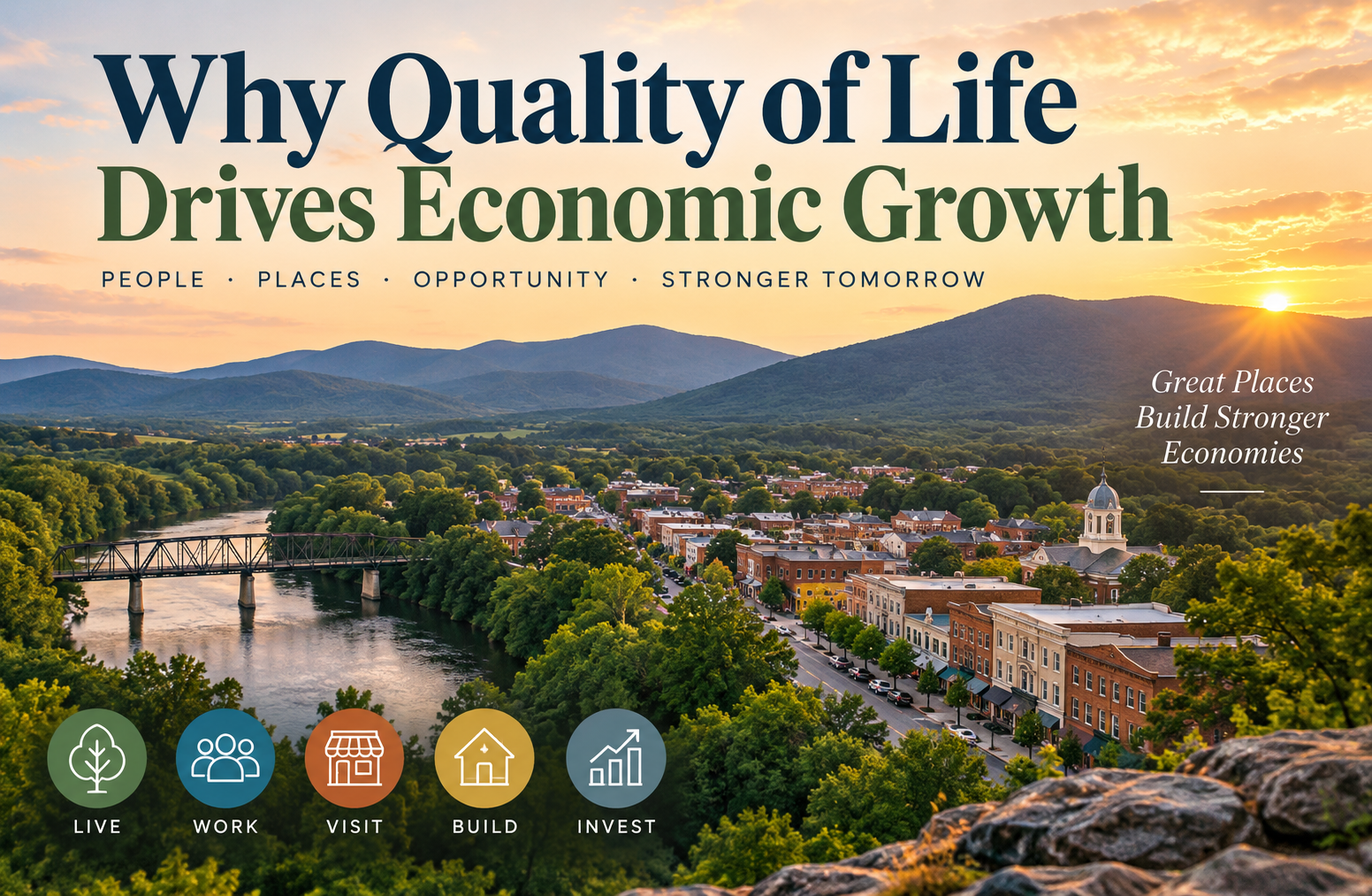
For decades, communities have approached economic development with a fairly simple formula:
Create jobs. Attract companies. Build commercial space. Expand the tax base.
Do those things successfully, the thinking goes, and a better quality of life will follow.
But what if we have it backwards?
What if quality of life isn't simply the reward a community receives after it becomes economically successful?
What if quality of life is one of the things that makes economic success possible in the first place?
I believe that's becoming increasingly important for communities like ours to understand.
People Have More Choices Than They Used To
There was a time when where you lived was largely determined by where you worked.
A company built a factory. Workers moved nearby. Houses followed. Stores opened to serve those households. The community grew around the employment center.
That relationship still exists, of course, but it isn't nearly as absolute as it once was.
Remote work has changed where some people can live. Entrepreneurs can operate businesses from places that would have been impossible a generation ago. Technology allows companies to serve customers around the country—or around the world—from a relatively small community.
And even when a job requires someone to be physically present, people have become much more willing to commute in exchange for living somewhere they actually want to be.
That changes the economic-development equation.
Increasingly, the question isn't simply:
"Where can I find a job?"
It's also:
"Where do I want to live?"
And communities that can answer that second question well have an enormous advantage.
Quality of Life Is Economic Infrastructure
When we hear the word "infrastructure," most of us probably think about roads, bridges, utilities, broadband and sewer capacity.
Those things absolutely matter.
But I would argue that parks are infrastructure too.
Trails are infrastructure.
A vibrant downtown is infrastructure.
Public spaces are infrastructure.
Arts, culture, recreation and community events are infrastructure.
Good schools are infrastructure.
Safe neighborhoods are infrastructure.
Access to nature is infrastructure.
Restaurants, breweries, coffee shops and locally owned stores are part of the equation too.
Not because every community needs to become some kind of entertainment district, but because all of these things help answer a fundamental economic question:
Do people want to live here?
If the answer is yes, something interesting begins to happen.
People bring their incomes with them.
They buy houses. They hire contractors. They eat at restaurants. They shop in local businesses. They pay taxes. They start companies. They volunteer. They invest in property. They invite friends and family to visit.
Some eventually employ other people.
Quality of life isn't separate from the economy.
It is part of the economic engine.
Talent Attracts Business Too
Economic development has traditionally spent enormous amounts of energy trying to attract employers.
But employers are trying to attract something themselves:
People.
A company can have the perfect building, affordable land and excellent highway access, but none of those things matter very much if it cannot recruit and retain the workers it needs.
That means companies increasingly have to think about the place surrounding the business.
Can employees find housing?
Are there things to do?
Are there good schools?
Can they enjoy the outdoors?
Is there a downtown?
Are there restaurants?
Does the community have an identity?
Could someone imagine raising a family there?
Could a young professional imagine building a life there?
Those questions may sound like lifestyle questions.
They're also workforce questions.
And workforce questions are economic-development questions.
The Small Things Become Big Things
This is one reason I believe communities sometimes underestimate the economic importance of seemingly small improvements.
A pocket park probably isn't going to generate hundreds of jobs.
Neither will a trail connection.
Neither will flowers along a downtown street.
Neither will a concert series.
Neither will preserving an attractive streetscape or creating a better pedestrian connection.
If we evaluate each one individually based solely on immediate financial return, many of these investments can appear insignificant.
But that's the wrong way to measure them.
Together, they create a place.
And places have value.
Think about communities you enjoy visiting.
Usually, it isn't one giant attraction that makes the place memorable. It's the collection of experiences.
The streets feel inviting.
There are interesting businesses.
People are outside.
There are places to gather.
Buildings have character.
There are things to see and do.
You remember how the place felt.
That feeling has economic value because it influences where people visit, where they spend money, where businesses invest and, ultimately, where people choose to live.
Tourism and Economic Development Are More Connected Than We Think
This is also where tourism and economic development begin to overlap.
A visitor might come to a community because of a national park, a festival, a historic site or a downtown event.
While they're there, they discover something else.
Maybe they like the downtown.
Maybe they notice the mountains.
Maybe they find a restaurant they love.
Maybe they start looking at real estate.
Maybe they begin imagining what it would be like to live there.
Not every tourist becomes a resident, obviously.
But tourism introduces people to places.
And sometimes today's visitor becomes tomorrow's homeowner, entrepreneur, remote worker or investor.
That's why tourism shouldn't exist in its own isolated box.
Neither should downtown development.
Neither should parks and recreation.
Neither should business development.
They are different pieces of the same larger product:
The community itself.
Growth Doesn't Always Mean Recruiting Something Huge
When people hear "economic growth," they often imagine landing a large employer.
And attracting employers certainly matters.
But there is another kind of economic growth that happens much more quietly.
A couple moves into town while keeping their remote jobs.
Someone opens a small restaurant.
A photographer starts a business.
A contractor hires another employee.
A retailer expands.
A family renovates an older house.
A visitor decides to purchase property.
An entrepreneur realizes they can operate their company from here.
None of those events individually generates a ribbon-cutting headline about 500 new jobs.
But multiply them across hundreds or thousands of people and they can fundamentally change a local economy.
That's economic development too.
In many cases, it may also be more resilient because the community isn't depending on a handful of large employers for its prosperity.
This Matters for Places Like Front Royal
Communities like Front Royal and Warren County have something many places spend enormous amounts of money trying to manufacture:
A sense of place.
We have mountains.
We have the Shenandoah River.
We have Shenandoah National Park at our doorstep.
We have Skyline Drive.
We have history.
We have a traditional downtown.
And we're within reach of one of the largest and wealthiest metropolitan areas in the country.
Those are extraordinary assets.
But having assets isn't the same thing as leveraging them.
The opportunity is to connect them.
Imagine thinking about downtown development, tourism, recreation, trails, public spaces, small businesses, housing and economic development not as separate responsibilities but as parts of one strategy.
The goal becomes bigger than simply attracting visitors.
And it becomes bigger than simply recruiting companies.
The goal becomes making this an increasingly desirable place to visit, live, work, build and invest.
When those things reinforce one another, economic growth becomes much more organic.
Build the Place People Want
None of this means communities should stop recruiting employers, improving infrastructure or developing commercial and industrial property.
We need those things too.
But they shouldn't be the entire strategy.
Because perhaps the most powerful economic-development question a community can ask isn't:
"How do we convince a company to come here?"
Maybe it starts with:
"How do we make this a place where people want to be?"
Build a community where people want to live, and you attract talent.
Attract talent, and you make the community more attractive to employers.
Create an environment where people want to visit, and you support local businesses.
Support local businesses, and you create more reasons for people to visit and live there.
Improve public spaces, recreation and community amenities, and property becomes more desirable.
Each piece strengthens the others.
It's an ecosystem.
For a long time, we treated quality of life as something economic growth would eventually allow us to afford.
Maybe it's time to recognize that quality of life is one of the investments that helps create economic growth in the first place.
Because in an economy where people increasingly have choices about where they live, work and invest, the communities that prosper may ultimately be the ones people simply choose to call home.
More from Scott Turnmeyer
I write about photography, business, mindset, bowling, and the bigger questions that don’t always have easy answers. You can explore more articles, photography, and projects here:
Blog Home
About Scott Turnmeyer
Fine Art Photography
Photography Workshops & Experiences
Digital Consulting