
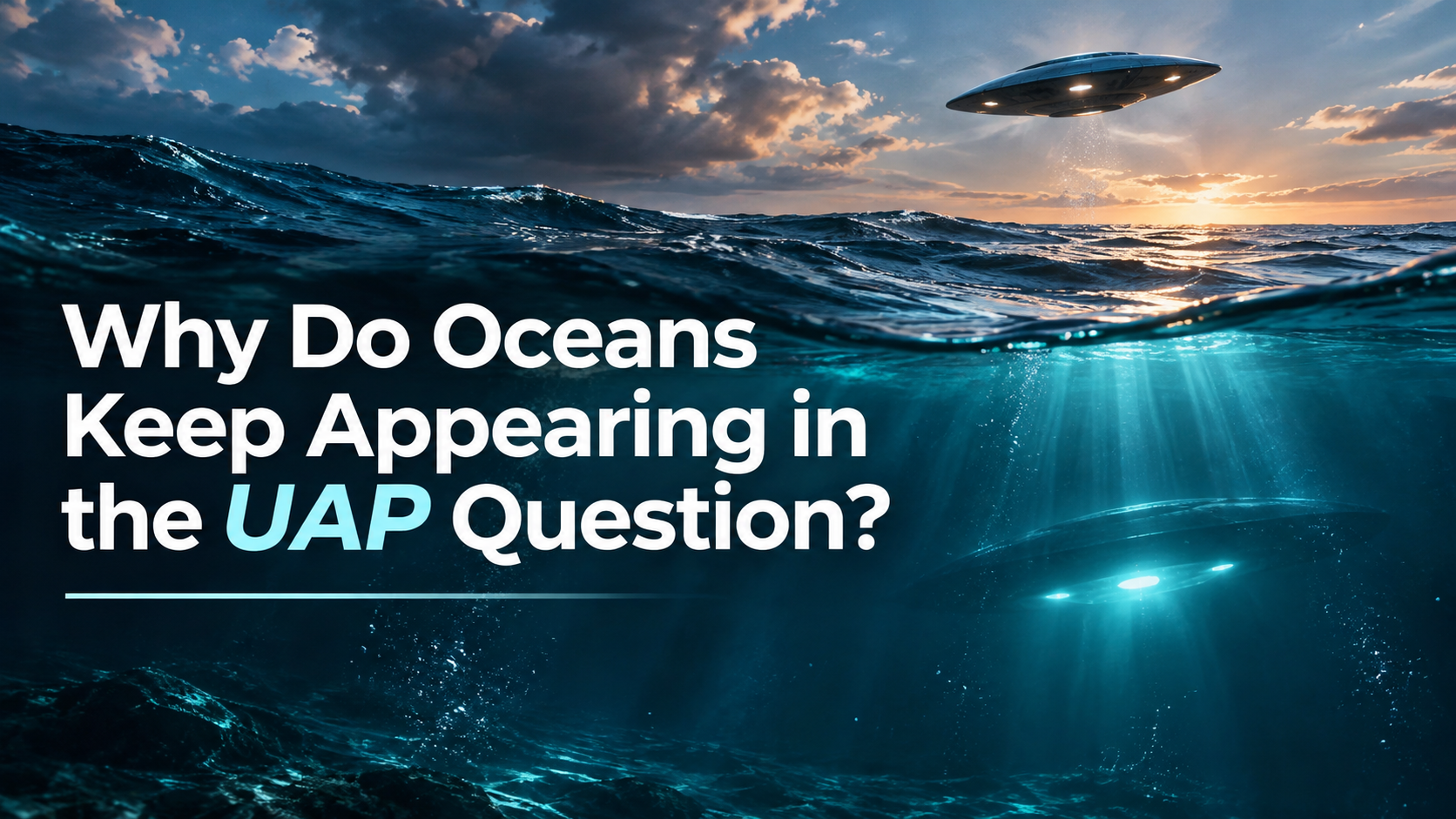
When most people think about unidentified anomalous phenomena, or UAPs, they picture something in the sky. Strange lights hovering over a field. An object moving at impossible speeds. A military pilot encountering something that doesn’t behave like a conventional aircraft.
But there’s another part of the UAP conversation that I find increasingly fascinating.
The ocean.
Again and again, when you start digging into military encounters, eyewitness accounts, and some of the more unusual claims surrounding UAPs, the world’s oceans seem to enter the picture.
Objects reportedly hovering over water. Unidentified contacts detected by military systems. Claims of craft entering the ocean without slowing down. And even suggestions that whatever may be behind some of these phenomena could be operating beneath the surface.
Some of those accounts are compelling. Others are unverified, exaggerated, or misunderstood.
But the recurring connection raises a question worth exploring.
Why do oceans keep appearing in the UAP question?
The Ocean Is Still One of Earth’s Greatest Mysteries
We live in an age when satellites can photograph the surface of Mars, telescopes can observe galaxies billions of light-years away, and artificial intelligence can analyze enormous amounts of information in seconds.
Yet we still have an incomplete understanding of much of our own ocean.
The ocean covers approximately 71% of Earth’s surface. Its average depth is roughly 12,000 feet, and its deepest trenches extend nearly seven miles beneath the surface.
And while we’ve mapped the broad contours of the seafloor, large areas have never been surveyed in high resolution or directly observed.
Think about that for a moment.
We spend enormous resources searching for signs of life elsewhere in the universe while significant portions of our own planet remain difficult to explore.
That doesn’t mean something extraordinary is hiding down there.
But it does mean we should be careful about assuming we know everything happening beneath the surface.
The ocean is an enormous environment where observation is difficult, communication is limited, and even sophisticated technology faces significant challenges.
If something unusual were operating there, detecting and identifying it might be far more difficult than most people realize.
The Navy’s Encounters Over Water
One of the most widely discussed UAP incidents occurred in November 2004, when U.S. Navy aviators operating near Southern California encountered an unidentified object during training exercises.
The incident, commonly called the Tic Tac encounter, involved pilots from the USS Nimitz carrier strike group.
Commander David Fravor and other witnesses described a white, oblong object displaying unusual flight behavior.
According to Fravor’s public testimony, the object was observed above an area of disturbed water.
That detail has always interested me.
Why was the water disturbed? Was something beneath the surface? Was the disturbance unrelated to the object? Could the pilots have misinterpreted something happening below them?
We don’t know.
And that’s an important distinction.
The presence of disturbed water doesn’t establish that the object emerged from the ocean or that another craft was beneath it.
But it adds another unexplained element to an already unusual encounter.
The broader significance of the Nimitz incident is that it involved trained military observers and multiple sources of information, including radar reports and pilot observations.
The public evidence, however, remains incomplete.
We have compelling testimony, but not enough publicly available sensor data to independently establish every extraordinary performance claim associated with the encounter.
That distinction matters if we’re serious about understanding what happened.
What About Objects Traveling Between Air and Water?
One of the more intriguing concepts in the UAP discussion is something called transmedium travel.
A transmedium vehicle can operate across different environments, such as air and water.
We already have technology that does this in limited ways. Certain drones and experimental vehicles can transition between aerial and underwater operations.
But the more extraordinary UAP claims describe objects moving between air and water without the dramatic changes in speed or behavior we would expect.
Consider the physics.
Air and water are very different environments. Water is approximately 800 times denser than air under typical conditions.
An object moving through the atmosphere at high speed faces one set of aerodynamic challenges.
An object moving through water at comparable speed faces dramatically greater resistance, pressure forces, and potential cavitation.
A craft transitioning between those environments at extreme speed without obvious deceleration, damage, or a significant disturbance would represent an extraordinary engineering achievement.
That’s why credible documentation of such an event would be so important.
But here’s the problem.
There is currently no publicly verified evidence establishing that an unidentified craft has demonstrated the extraordinary air-to-water capabilities sometimes attributed to UAPs.
There are reports and interpretations. There are videos that have generated considerable debate. There are witnesses who believe they’ve observed something unusual.
But none of that is the same as independently verified proof.
The distinction doesn’t make the subject less interesting.
It makes the need for better evidence more important.
The Puerto Rico Video
One frequently discussed example is a 2013 infrared video recorded by a U.S. Customs and Border Protection aircraft near Aguadilla, Puerto Rico.
The footage appears to show an unidentified object moving across the landscape and near the ocean.
Some UAP researchers have interpreted the video as showing an object entering the water, continuing underwater, and later splitting into two objects.
If that interpretation were correct, it would be remarkable.
But the video has also been analyzed by skeptics and technical researchers who argue that perspective, sensor behavior, and an ordinary airborne object could explain what appears on screen.
The central issue is that infrared footage is not always intuitive.
Objects can appear to move differently depending on the camera’s position, tracking system, angle, and the temperature contrast between the object and its surroundings.
A visual impression of something entering the water doesn’t necessarily mean it actually did.
Without reliable distance measurements, supporting sensor information, and independent confirmation, the more extraordinary interpretation remains unproven.
Still, the incident illustrates why ocean-related UAP claims continue to attract attention.
Sometimes the imagery is genuinely puzzling, even when the most dramatic explanation isn’t established.
Could Something Be Operating Beneath the Surface?
This is where the discussion becomes especially speculative.
Some researchers and former government officials have suggested that at least a portion of the UAP phenomenon could involve an intelligence operating on Earth rather than arriving from another planet.
One version of that hypothesis proposes an unknown presence associated with the oceans.
The reasoning usually follows a few basic ideas.
First, the oceans provide enormous areas that are difficult to observe continuously.
Second, deep-water environments offer natural concealment from conventional human activity.
Third, if an advanced intelligence possessed technology capable of operating underwater for extended periods, it might be able to remain largely undetected.
And fourth, the repeated appearance of oceans in certain UAP accounts could potentially indicate something more than coincidence.
It’s an interesting hypothesis.
But there is a very large gap between saying the oceans could conceal something and demonstrating that they actually do.
We have no publicly verified evidence of an advanced nonhuman civilization operating beneath Earth’s oceans.
No confirmed underwater bases. No independently authenticated vehicles. No publicly verified biological or technological artifacts establishing such a presence.
That doesn’t make the hypothesis logically impossible.
It simply means that, at present, it remains speculation.
And speculation should never be confused with discovery.
There’s Another Explanation We Should Consider
One possibility that doesn’t receive enough attention is that the ocean connection may be partly the result of where our most sophisticated detection systems operate.
The U.S. Navy operates aircraft carriers, submarines, surface vessels, radar networks, sonar systems, and advanced surveillance aircraft.
These systems are designed to detect things that ordinary people would never notice.
Military training areas also tend to be located offshore, away from densely populated regions.
So when military personnel encounter unidentified objects, many of those encounters naturally happen over water.
That creates a potential observational bias.
If we concentrate powerful sensors around the ocean, we’re likely to detect more unusual things around the ocean.
The same principle applies to astronomy.
Point a telescope toward a particular region of the sky long enough, and you’ll discover things that were previously unknown there.
That doesn’t necessarily mean the region contains an unusual concentration of mysteries.
It may simply mean that’s where we’ve been looking.
This explanation doesn’t account for every UAP report.
But it is an important possibility to consider before concluding that the ocean itself has special significance.
What Does the Government Actually Know?
This is one of the most frustrating parts of the UAP conversation.
The public often receives fragments of information.
A pilot’s testimony. A short video. A statement from a former intelligence official. A government report acknowledging that certain cases remain unresolved.
But the underlying data is frequently unavailable.
Some information is classified because revealing it could expose military sensor capabilities, surveillance methods, or operational locations.
That is a legitimate national security concern.
At the same time, it creates an environment where extraordinary claims can flourish without independent verification.
The Department of Defense’s All-domain Anomaly Resolution Office, or AARO, has investigated reports involving unidentified phenomena across multiple environments.
Its public findings have not established that UAPs represent extraterrestrial or nonhuman technology.
NASA has likewise emphasized the importance of better data, standardized reporting, and rigorous scientific analysis.
Neither conclusion means every reported incident has been explained.
An unresolved case simply means investigators lack enough information to confidently identify what occurred.
It does not automatically become evidence of something extraordinary.
Still, I believe the public deserves as much transparency as national security reasonably allows.
If the government possesses high-quality evidence of unusual objects operating in or around the oceans, that evidence deserves serious scientific examination.
Not sensationalism.
Not ridicule.
Actual investigation.
What Would Convincing Evidence Look Like?
For me, this is where the discussion needs to go.
Imagine an unidentified object being tracked by radar as it approaches the ocean.
A second sensor confirms its position and velocity.
The object enters the water.
Sonar then detects the same object continuing beneath the surface, with synchronized timing and location data supporting a continuous track.
Additional sensors establish its speed, depth, and movement.
And independent experts are allowed to analyze the information.
That would be an extraordinary dataset.
It would not automatically prove extraterrestrial intelligence, but it could establish that something genuinely unusual had occurred.
Compare that with a blurry video, a secondhand story, or an anonymous claim about an underwater facility.
Those may be reasons to investigate.
They aren’t enough to reach a conclusion.
The difference is evidence.
And if the UAP question is ever going to move beyond endless speculation, evidence must become the center of the conversation.
What If We’re Asking the Wrong Question?
Most of the public discussion surrounding UAPs focuses on where they might come from.
Another planet? Another solar system? Somewhere beyond our current understanding of physics?
But what if the more useful initial question is simply where the unexplained observations are occurring, and under what conditions?
Perhaps some reports involve advanced human technology.
Perhaps others involve atmospheric effects, sensor limitations, or ordinary objects behaving in unexpected ways.
And perhaps a small number will eventually reveal something we genuinely don’t understand.
We shouldn’t decide the answer before examining the evidence.
The ocean hypothesis is fascinating because it challenges the assumption that every mystery associated with UAPs must begin somewhere in outer space.
But an interesting possibility is not the same thing as a demonstrated reality.
I don’t believe we should dismiss the idea simply because it sounds unusual.
I also don’t believe we should accept it because a compelling story makes it seem plausible.
Both approaches get in the way of discovering the truth.
My Take: The Ocean Connection Deserves Investigation, Not Assumptions
I keep coming back to one simple thought.
We know the oceans are vast. We know they are difficult to monitor. We know military personnel have reported unusual objects operating over water. And we know some UAP cases remain unresolved.
Those are legitimate facts worth discussing.
What we don’t know is whether those facts point toward a meaningful connection between UAPs and the oceans.
Maybe they do.
Maybe they don’t.
But the answer won’t come from assuming every unidentified object is a visitor from another world, or that every unusual radar contact represents something beyond human technology.
It will come from better observations, better data, and a willingness to investigate without deciding the outcome in advance.
Personally, I find the possibility that we still have profound mysteries here on Earth every bit as fascinating as the possibility of life elsewhere in the universe.
Maybe the greatest discovery waiting for us isn’t millions of miles away.
Maybe it’s much closer.
Somewhere beneath the waves.
And until we have the evidence to know for certain, I think it’s a question worth continuing to ask.
More from Scott Turnmeyer
I write about photography, business, mindset, bowling, and the bigger questions that don’t always have easy answers. You can explore more articles, photography, and projects here:
Blog Home
About Scott Turnmeyer
Fine Art Photography
Photography Workshops & Experiences
Digital Consulting