
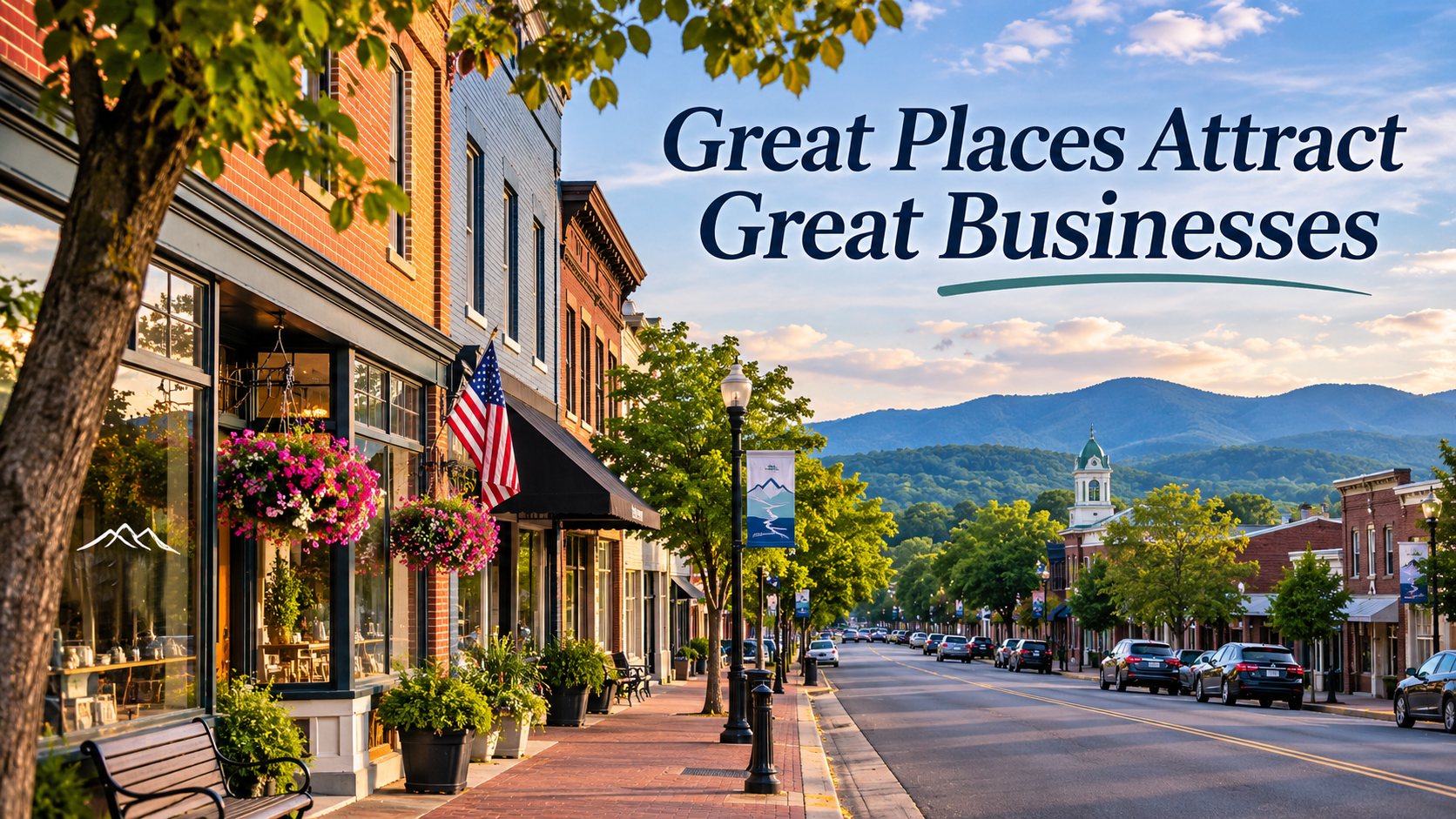
Why the future of economic development begins with the community we create.
When communities talk about economic development, the conversation often begins with attracting new businesses. We talk about available commercial properties, tax incentives, infrastructure, workforce development, and what it might take to convince a company to choose our community over another.
Those are all important pieces of the puzzle. But I believe we’re missing something fundamental.
Great places attract great businesses. Not the other way around.
That might seem like a small distinction, but I think it represents an entirely different way of approaching economic development.
Instead of asking what we can offer a business to convince it to locate here, perhaps we should first be asking a more important question:
Are we building a community where people genuinely want to be?
People Choose Places
There was a time when economic development was largely driven by the availability of jobs. A major employer would establish operations in a community, workers would follow, neighborhoods would grow, and supporting businesses would emerge.
That model still exists, particularly in manufacturing and industries that require significant physical infrastructure. But the world has changed.
Technology, remote work, entrepreneurship, and changing lifestyle priorities have given many people more freedom to choose where they live and work.
Increasingly, people are looking for something beyond a paycheck. They want quality of life. They want character, community, outdoor recreation, interesting places to eat and shop, and opportunities to connect with the people around them.
They want to live somewhere that feels like a place rather than simply a collection of buildings.
And when talented, motivated, entrepreneurial people choose a community, businesses often follow.
Some of those people start their own businesses. Others bring professional skills, investment, and connections. Some work remotely for companies hundreds of miles away while spending their income locally.
The common denominator is that they chose the place first.
Tourism Is More Than Visitors
Living and operating a business in Front Royal has given me a unique perspective on the relationship between tourism and economic development.
We have something that many communities would spend millions of dollars trying to create: an extraordinary natural setting.
The Shenandoah River, the Blue Ridge Mountains, Skyline Drive, and Shenandoah National Park are assets that cannot simply be replicated somewhere else.
Every year, people travel here because they want to experience what we have in our backyard.
But I think we sometimes underestimate what those visitors represent.
A tourist visiting Front Royal for the weekend is certainly an opportunity for our restaurants, shops, lodging properties, and attractions. That visitor contributes directly to our local economy.
But that visitor is also a potential future resident, entrepreneur, investor, or employer.
Think about how often someone visits a beautiful community and says, “I could see myself living here.”
That statement is the beginning of something much bigger than tourism.
It represents an opportunity for economic development.
The challenge is making sure the experience people have when they arrive reinforces that initial attraction.
Do they discover a vibrant downtown? Are there interesting businesses to explore? Do public spaces feel welcoming? Can they find reasons to stay longer, return again, and eventually imagine becoming part of the community?
Or do they simply pass through on their way to somewhere else?
Tourism introduces people to a community. The community itself determines whether they want to come back.
Downtown Is an Economic Development Asset
I have written before about the hidden costs of empty storefronts, and I believe that discussion connects directly to this larger idea.
A thriving downtown is much more than a collection of retail establishments.
It is one of the most visible representations of a community’s identity.
When someone walks down Main Street, they are forming an impression of the entire area. The condition of the buildings, the variety of businesses, the activity on the sidewalks, and the atmosphere all contribute to that impression.
A downtown filled with independent businesses, restaurants, galleries, and gathering places tells a story about a community that people care about.
Empty storefronts, neglected properties, and a lack of activity tell a different story.
That perception matters.
Imagine an entrepreneur considering relocating a business to Front Royal. Before making that decision, they will likely visit, explore, eat at local restaurants, and spend time getting to know the area.
What they experience outside the potential business location may influence their decision just as much as the property itself.
A strong downtown helps attract residents, employers, entrepreneurs, and investment throughout the community.
And those new residents and businesses, in turn, help support downtown.
It’s a cycle that can build momentum over time.
Small Businesses Create the Character
One of the things I have come to appreciate as a small business owner is how much independent businesses contribute to the personality of a community.
A national chain can provide convenience, jobs, and investment. Those are valuable contributions.
But independent businesses often provide something different.
They create distinction.
They give people a reason to explore one downtown instead of another. They introduce visitors to local products, artists, stories, and experiences that cannot be found everywhere.
They also create relationships.
The business owner sponsoring a local event, supporting a school fundraiser, helping another entrepreneur, or simply remembering a customer’s name is contributing something that doesn’t appear on an economic development spreadsheet.
They are building community.
And community is increasingly one of the things people are looking for.
This is why I believe supporting existing businesses should be just as important as recruiting new ones.
We sometimes become so focused on the next big opportunity that we overlook the businesses already investing in our communities every day.
Helping those businesses succeed, expand, and collaborate strengthens the foundation upon which future economic development depends.
Economic Development and Destination Development Belong Together
Traditionally, tourism and economic development have often operated as separate functions.
Tourism organizations focus on attracting visitors. Economic development organizations focus on attracting businesses and investment.
But I believe the two are far more connected than we sometimes acknowledge.
A successful destination attracts attention. Attention creates interest. Interest creates opportunities.
When people discover a community they love, some will want to return. Others will want to live there. And some will see an opportunity to build something there.
That progression doesn’t happen automatically.
It requires intentional destination development.
And there is an important difference between destination marketing and destination development.
Marketing tells people why they should visit.
Development makes sure there is something worth visiting.
That means investing in the experiences, public spaces, infrastructure, businesses, events, and partnerships that make a community attractive in the first place.
It means thinking about how the visitor experience connects to the resident experience.
And it means recognizing that improvements made for visitors frequently benefit the people who live here every day.
A more walkable downtown, better public spaces, expanded recreation opportunities, attractive streetscapes, and a stronger local business community don’t stop being valuable when tourist season ends.
They improve quality of life for everyone.
That is why I believe destination development should be viewed as a core component of economic development rather than simply a tourism initiative.
We Have to Think Beyond the Next Business
Economic development is often measured through numbers: jobs created, capital investment, tax revenue, commercial occupancy, and new business announcements.
Those are legitimate and important measurements.
But I think we also need to consider the conditions that make those outcomes possible.
Are we becoming a more attractive place to live?
Are we giving young people reasons to stay or return after college?
Are we creating opportunities for entrepreneurs?
Are our public spaces improving?
Are we protecting the natural and historic assets that make our community unique?
Are we building an environment where existing businesses can thrive?
Those questions may not produce immediate ribbon-cutting ceremonies, but they help determine what our community will look like ten or twenty years from now.
And I would argue that they are among the most important economic development questions we can ask.
Front Royal Has an Extraordinary Opportunity
I believe Front Royal and Warren County are uniquely positioned to benefit from this approach.
We sit at the northern entrance to Shenandoah National Park, surrounded by natural beauty and outdoor recreation opportunities. We have a historic downtown, a strong sense of local identity, and access to the economic opportunities of Northern Virginia without being completely defined by them.
Those are significant advantages.
But having great assets and becoming a great destination are not necessarily the same thing.
The opportunity before us is to connect those assets into a compelling experience for visitors and residents alike.
That requires collaboration between local government, tourism organizations, businesses, property owners, nonprofit organizations, and the people who call this community home.
It requires recognizing that tourism, downtown revitalization, small business development, and quality of life are not competing priorities.
They are interconnected parts of the same strategy.
And perhaps most importantly, it requires us to think about what we want Front Royal and Warren County to become rather than simply reacting to whatever opportunity comes along next.
Build the Place, and Opportunity Will Follow
I don’t believe that creating a great community eliminates the need for traditional economic development. We will always need infrastructure, workforce development, appropriate commercial space, and thoughtful business recruitment.
But those efforts become more effective when they are supported by a place that people already want to be.
Businesses need customers. Employers need talented people. Entrepreneurs need an environment where they can succeed.
And people increasingly have choices about where they spend their time, their money, and their lives.
Our job is to make our community one of those choices.
Not by trying to become something we’re not, but by investing in what makes us special.
By supporting the businesses already here.
By making our downtowns vibrant and welcoming.
By protecting and celebrating our natural beauty.
By creating experiences that turn first-time visitors into lifelong advocates.
And by building a community that the next generation will be proud to call home.
Because ultimately, the most sustainable economic development strategy may also be the simplest:
Build a place people love, and give businesses a reason to be part of it.
— Scott Turnmeyer
More from Scott Turnmeyer
I write about photography, business, mindset, bowling, and the bigger questions that don’t always have easy answers. You can explore more articles, photography, and projects here:
Blog Home
About Scott Turnmeyer
Fine Art Photography
Photography Workshops & Experiences
Digital Consulting